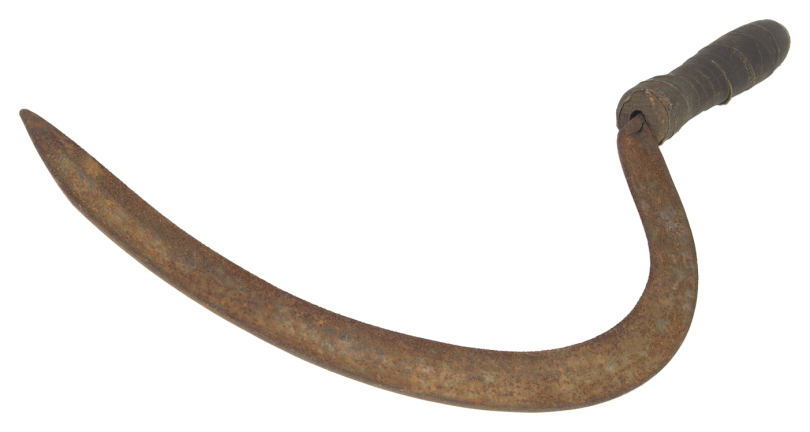
Another angel had a sharp sickle – Revelation 14:17-18

Previously: The earth was harvested – Revelation 14:15-16

The scripture

Rev. 14:17 – Then another angel who also had a sharp sickle came out of the sanctuary in heaven. 18 Yet another angel, who had authority over fire, came from the altar, and he called with a loud voice to the one who had the sharp sickle, “Use your sharp sickle and gather the clusters of grapes from earth’s vineyard, because its grapes have ripened.” (HCSB)

Another angel had a sharp sickle

Next, we encounter the fourth angel of Revelation 14. Like the One seated on the cloud, he also wields a sharp sickle and comes out of the sanctuary in heaven. A fifth angel follows him, and this one is said to have “authority over fire.” He calls in a loud voice to the fourth angel, “Use your sharp sickle and gather the clusters of grapes from earth’s vineyard, because its grapes have ripened” (v. 18).

sickleThis passage echoes Joel 3:9-13 in which grape harvesting and wine pressing are used as metaphors for judgment, and Isa. 63:1-6 in which God treads the grapes in His fury, pressing out the lifeblood of people. The same metaphor is found in Jer. 25:15, 28-31. Judgment also is symbolized by the harvest in Jer. 51:33 and Hosea 6:11. Moreover, it is the Messiah who treads the winepress in Rev. 19:15.

Why are we told about the angel that has “authority over fire?” Perhaps this is connected to the fifth seal in Rev. 6:9-11. Here, martyrs “under the altar” cry out to God for vengeance. Later, in the seventh seal, an angel with a gold incense burner stands at the altar. He is given a large amount of incense to offer with the prayers of all the saints on the gold altar in front of the throne. The angel takes the incense burner, fills it with fire from the altar, and hurls it to the earth, which results in rumblings of thunder, flashes of lightning, and an earthquake. This also helps prepare the seven angels to usher in the next series of judgments.

Continue reading

Is the canon of Scripture closed?

holy-bibleSome Christian scholars today cast doubt over the canon of Scripture – those 66 books that the Church has long held to be the complete written revelation of God. They justify their views by claiming: (1) that surviving texts of the Old and New Testaments are corrupt and therefore unreliable, or (2) that early Church leaders deliberately excluded certain books for personal or political reasons.

As Craig L. Blomberg responds in his recent book – Can We Still Believe the Bible? – “there is not a shred of historical evidence to support either of these claims; anyone choosing to believe them must do so by pure credulity, flying in the face of all the evidence that actually exists.”

But what if we discovered an apostolic writing that has remained hidden for the last 2,000 years?

For example, in 1 Cor. 5:9, Paul alludes to an earlier letter to fellow believers in Corinth. We don’t have that letter, nor are we aware of its specific contents. Let’s say, however, that archaeologists unearth a clay pot containing a manuscript dating from the mid-first century and fitting the description of Paul’s letter.

Should the Church welcome 3 Corinthians as the 28th book of the New Testament? Not so fast.

Continue reading

A survey of Roman Catholicism

Jesus with lambThe Roman Catholic Church traces its beginning to the apostle Peter, claiming he is the rock upon whom Jesus built His church (Matt. 16:18). As the first pope, Peter is followed by an unbroken line of successors stretching to Pope Francis today. Non-Catholics establish the beginning of the Roman Catholic Church at A.D. 590 with Gregory I, who consolidated the power of the bishopric in Rome.

In any case, the Catholic Church is the world’s largest Christian church, with 1.2 billion members. The Catholic hierarchy includes cardinals and bishops and is led by the bishop of Rome, also known as the pope.

The Catholic Church teaches that it is the one true church divinely founded by Jesus Christ. In addition, it teaches that its bishops are the successors of Jesus’ apostles, and that the pope, as the successor to the head of the apostles (Peter), has supreme authority over the church.

Categories of Catholics

While the Catholic Church claims to be the one true church, Catholics worldwide hold to a diversity of beliefs. Researcher Ken Samples has concluded that there are six primary categories of Roman Catholics:

Ultratraditional Catholics defend historical Catholicism and are critical of recent changes such as those coming out of Vatican II in the 1960s.

Traditional Catholics resist liberalism and modernism within the church, yet they generally accept the reforms of Vatican II.

Liberal Catholics celebrate human reason over the authority of the church; they also question the infallibility of the pope, church councils, and the Bible

Charismatic/evangelical Catholics emphasize the gifts of the Holy Spirit, the importance of being baptized in the Holy Spirit, and the Spirit-filled life.

Cultural Catholics are “womb-to-tomb” Catholics – born, baptized, married, and buried in the church. However, they essentially go through the motions of their faith without much regard for its meaning.

Popular folk Catholics predominate Central and South America. They combine elements of animistic or nature-culture religion with traditional medieval Catholicism (Christian Research Journal, Winter 1993).

Continue reading

The bankruptcy of the prosperity pospel

FEX_018Leaders of the word-faith movement, also known as the prosperity gospel, say they place a high value on scripture. Unfortunately, their unique interpretation of God’s word leads to unbiblical conclusions about God’s design for the Christian life.
A case in point: 3 John 2, which reads: “Dear friend, I pray that you may prosper in every way and be in good health, just as your soul prospers.”

As prosperity preachers like Kenneth Copeland and Joel Osteen would have you believe, this verse expresses the divine view that every child of God should enjoy financial blessing and perfect health. But is that what the passage really means?

Hardly. In the first place, the Greek word translated “prosper” means “to go well,” not to become rich. Secondly, John uses a common greeting to address his friend, Gaius, similar to salutations we place in modern-day letters.

As Gordon Fee writes in The Disease of the Health and Wealth Gospels, “This combination of wishing for ‘things to go well’ and for the recipient’s ‘good health’ was the standard form of greeting in a personal letter in antiquity. To extend John’s wish for Gaius to refer to financial and material prosperity for all Christians is totally foreign to the text.”

Continue reading

The earth was harvested – Revelation 14:15-16

Previously: One like the Son of Man – Revelation 14:14

The scripture

Rev. 14:15 – Another angel came out of the sanctuary, crying out in a loud voice to the One who was seated on the cloud, “Use your sickle and reap, for the time to reap has come, since the harvest of the earth is ripe.” 16 So the One seated on the cloud swung His sickle over the earth, and the earth was harvested. (HCSB)

The earth was harvested

John picks up the narrative in verses 15-16: “Another angel came out of the sanctuary, crying out in a loud voice to the One who was seated on the cloud, ‘Use your sickle and reap, for the time to reap has come, since the harvest of the earth is ripe.’ So the One seated on the cloud swung His sickle over the earth, and the earth was harvested.”

sickleThe harvest in these verses, though not stated explicitly, refers to wheat or barley. The word for ripe (Gr.: xeraino) describes dried heads of grain and is different than the word used of ripened grapes in verse 18.

The phrase “another angel” does not imply that the “One like the Son of Man” is an angel. John simply is continuing his observation from the point of the three angels in verses 6-13. This angel comes out of the sanctuary and heads straight for the One holding the sickle. He bears a message from God the Father, who is seated on His throne in the heavenly Holy of Holies (Rev. 6:9; 8:3; 11:19). The message is simple: The time to reap has come; the earth is ripe for harvest. The One seated on the cloud asks no questions, nor does He hesitate. He swings His sickle over the earth, and it is harvested.

No doubt this is a harvest of people on the earth. But who are they? Commentators differ in their understanding of this passage. Some believe this is the harvest of the just, coming before the harvest of the unbelievers (vv. 17-20); it is distinct just as the wheat harvest is distinct from the harvest of grapes. Others, however, argue that scripture normally speaks only of unbelievers being cut down. Therefore, both the One like the Son of Man and the angel with the sickle are engaged in destroying the wicked; one harvest, two perspectives.

Continue reading