
Tagged: Trinity

Why study the Trinity?
 This is the first in a series of columns on the Trinity.
Would it surprise you to know that six out of 10 U.S. adults say the Holy Spirit is a force, not a personal being? Or, more shocking, that 78 percent of Americans with “evangelical beliefs” agree with the statement that Jesus was the first and greatest being created by God the Father?
These views, part of Ligonier Ministries’ 2018 State of Theology survey of 3,000 Americans, expose the soft underbelly of evangelical Christianity in our country.
If Jesus is God’s first and greatest created being, then Arius, the fourth-century heretic, was right after all. On the other hand, if Jesus is the uncreated, eternal Son of God, then the church has made little headway in promoting sound doctrine since the councils of Nicaea and Constantinople pushed back against Arianism.
Continue reading
What Every Christian Should Know About the Trinity
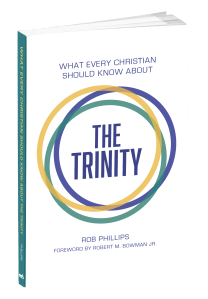
The doctrine of the Trinity distinguishes orthodox Christianity from counterfeit forms of the faith, and sets Christianity apart from other monotheistic religions such as Judaism and Islam. Even so, many Christians struggle to understand and explain this non-negotiable doctrine.
What Every Christian Should Know About the Trinity explores the biblical foundation of belief in one true and living God, who exists as three distinct, but inseparable, co-equal, co-eternal persons: Father, Son, and Holy Spirit.
Written for pastors and laypersons alike, this new resource features twelve lessons that conclude with probing questions, making this an ideal resource for personal or group study.
Written by the Missouri Baptist Convention’s Rob Phillips, the book features a foreword from noted apologist Robert M. Bowman Jr.
Available in print from the MBC.
Or, get a print or Kindle edition from Amazon.

The personhood of the Holy Spirit
 This is the first in a two-part series on the Holy Spirit.
One way the Jehovah’s Witnesses’ New World Translation (NWT) seeks to undermine the Trinity is by consistently rendering the name “Holy Spirit” as the inanimate “holy spirit.”
The unnamed translators of the NWT often omit the article “the,” which results in stilted verses such as:
“That one [Jesus] will baptize you with holy spirit …” (Matt. 3:11).
John the Baptist “will be filled with holy spirit even from before birth” (Luke 1:15).
Mary, the mother of Jesus, “was found to be pregnant by holy spirit …” (Matt. 1:18).
As James White notes in The Forgotten Trinity, “Their intention is clear: the Watchtower society denies that the Holy Spirit is a person, hence, they desire their ‘translation’ of the Bible to communicate the idea that the Holy Spirit is an ‘it,’ a force or power.”
The Watch Tower argues that the phrase “Holy Spirit” in Greek is in the neuter gender, and it is. But Greek genders do not necessarily indicate personality, according to White. Inanimate things can have masculine and feminine genders, and personal things can have the neuter gender.
A better way to determine whether the “Holy Spirit” is personal or inanimate is the same way we seek to understand whether the Father and Son are personal. That is, does the Holy Spirit offer evidence of personhood? Does He speak, use personal pronouns, have a will, and so on?
The answer, of course, is a resounding yes.
Continue reading

Three personal questions about God
 This is the last in a series of articles contrasting Allah and Yahweh.
Previously: The Islamic Inquisition
Muslims and Christians agree that there is one God but understand Him differently. While it is politically correct to say Christians and Muslims worship the same God, no Muslim or Christian who truly understands his faith would agree with that statement.
In fact, we can see that Christians and Muslims worship distinctly different Gods by asking three personal questions: (1) Does God know me? (2) Does God love me? (3) Did God die for me?
Continue reading
The Islamic Inquisition
 This is the fourth in a series of articles contrasting Allah and Yahweh.
Previously: A Simple Start to Understanding the Trinity
Christians and Muslims agree that God is one. Christians believe in a triune God: one being in three persons. But Islam’s understanding of Allah as a monad — monolithic and non-relational — creates two significant challenges to a consistent doctrine of God in Islamic theology.
First, how do Muslims reconcile their belief that Allah is eternal and self-existent with their belief that the Qur’an also is eternal? It seems either that the Qur’an came into being, or there are two eternally existing entities: Allah and his word.
Second, since the Qur’an depicts Allah as loving, merciful, and gracious, with whom was he loving, merciful, and gracious before he decided to create? It seems that Allah and his attributes are contingent upon creation.
These issues, particularly the first one, prompted the Minha, an Islamic inquisition in the 9th century.
Continue reading
 OnceDelivered.net