
Tagged: Christian apologetics
Apologetics 101 — Download Free Resources
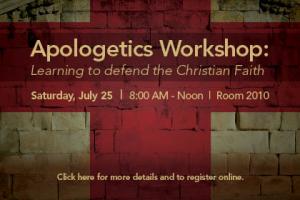 Here are all the resources used in the fall 2009 Apologetics 101 series at Brentwood Baptist Church. Feel free to print multiple copies, save and forward the files electronically, and use the resources in any way helpful to your ministry. The only restrictions are that you do not sell these resources or alter the content in any way. Thanks for your interest in helping other believers defend the Christian faith.
How to Identify False Prophets
Apologetics 101: Part 8 — How can I identify false prophets?
This is session eight in a 10-part series designed to help Christians defend their faith
How to identify false prophets (audio)
How to identify false prophets (pdf)
“But I fear that, as the serpent deceived Eve by his cunning, your minds may be corrupted from a complete and pure devotion to Christ. For if a person comes and preaches another Jesus, whom we did not preach, or you receive a different spirit, which you had not received, or a different gospel, which you had not accepted, you put up with it splendidly!” (2 Cor. 11:3-4 HCSB)
The words of the apostle Paul are clear: Those who are not grounded in the Word of God are subject to deceptive teachings about “another Jesus … a different spirit … a different gospel” – three distinctive markers that help us identify false prophets. Whether they are Muslim prophets like Muhammad, or self-proclaimed messiahs like the Rev. Sun Myung Moon, these false teachers invariably promote an unbiblical view of Jesus, the Holy Spirit, and the Gospel. We will use these three markers, along with a comparative chart, to examine the teachings of Islam, Mormonism, and the Jehovah’s Witnesses in light of what God’s Word proclaims.
The Bible cautions us to beware of false messiahs, false prophets and false teachers who “disguise themselves as servants of righteousness” and promote “doctrines of demons” (see Matt. 24:24; 2 Cor. 11:13-15; 1 Tim. 4:1; 2 Tim. 4:3-4). But before we go deeper, let’s define some key terms.
Defining our terms
False religion. From a New Testament perspective, a false religion is any system of belief that opposes the central teachings of the Christian faith. While all cults of Christianity are false religions, not all false religions are cults, because not all religions claim to be Christian. Islam, for example, is a false religion but not a cult, because Islam does not claim to be Christian.
Cult. A cult is a religious organization whose members claim to be Christians, and who use the Bible and Christian terms, yet who deny the central beliefs of historical Christianity. Simply put, a cult is a counterfeit form of Christianity.
Heresy. This may be defined as a teaching strongly opposed to the doctrines of historical Christianity, for example the denial of Christ’s deity, full humanity, virgin birth, or bodily resurrection.
Sect. A sect is an otherwise orthodox group having established its own identity and teachings distinct from the group to which it belongs. In Jesus’ day for example, the Pharisees, Sadducees and Essenes were sects of Judaism.
Another Jesus, a different spirit, a different gospel
Every Christian can identify false belief systems by asking three important questions: 1) Who is Jesus? 2) Who is the Holy Spirit? and 3) How am I saved? As we go to the comparative chart and place the teachings of God’s Word against the teachings of Islam, Mormonism and the Jehovah’s Witnesses, let’s remind ourselves of some key biblical truths that address these crucial questions.
Key truths about the real Jesus
Jesus is:
- The eternal Son of God, without beginning or end
- God / deity
- Co-equal and co-eternal with the Father and the Holy Spirit
- Virgin born
- The God-Man / fully divine and fully human
- Sinless in His humanity
- Our substitute through His sacrificial death on the cross
- Alive, having been raised physically from the dead
- The only way of salvation
- Seated today in heaven as our Mediator and Intercessor
- Coming visibly and physically one day in power and great glory
- The One who will judge all people and to whom, one day, all creatures will bow
Key truths about the real Holy Spirit
The Holy Spirit is:
- The eternal Spirit, without beginning or end
- God / deity
- Personal (not an impersonal force)
- Co-equal and co-eternal with the Father and the Son
- The Author of Scripture
- The One who convicts the lost of their need for Christ
- The One who regenerates believing sinners, causing them to be made spiritually alive
- The One who indwells, seals and sanctifies believers, and who places them positionally into the Body of Christ
- The Giver of spiritual gifts
- God’s down payment /guarantee of our home in heaven
Key truths about the real Gospel
- All people are sinners
- Sin separates us from holy God, resulting in spiritual and physical death and, ultimately, eternity apart from God in hell
- People are incapable of saving themselves
- Christ died on the cross for our sins and, as our Substitute, paid our sin debt in full
- Christ was buried and rose physically from the dead
- His finished work at Calvary conquered sin and death for us
- As a result, salvation is by God’s grace through faith – not by works
- Salvation is God’s gift – and everlasting, unbreakable, covenant relationship with Him
An exhortation from John the apostle
Dear friends, do not believe every spirit, but test the spirits to determine if they are from God, because many false prophets have gone out into the world. This is how you know the Spirit of God: Every spirit who confesses that Jesus Christ has come in the flesh is from God. But every spirit who does not confess Jesus is not from God. This is the spirit of the antichrist; you have heard that he is coming, and he is already in the world now. You are from God, little children, and you have conquered them, because the One who is in you is greater than the one who is in the world. (1 John 4:1-4 HCSB)
The Bible not only warns believers about false prophets; it describes them graphically as:
- Ravaging wolves in sheep’s clothing (Matt. 7:15; see also Acts 20:29)
- Deceitful workers (2 Cor. 11:13)
- Springs without water, mists driven by a whirlwind (2 Peter 2:17)
- Dreamers who defile their flesh, despise authority, and blaspheme glorious beings (Jude 1:8)
- Liars (Rev. 2:2)
- Antichrists (1 John 2:18)
How do we define a false prophet? Simply put, a false prophet is one who preaches, teaches, or foretells events contrary to the Word of God – sometimes claiming God as his or her source. As believers, we can guard our hearts from the teachings of false prophets by obeying three commands of the apostle John:
- Do not believe every spirit. Kenneth Wuest’s translation of 1 John 4:1 puts it this way: “Stop believing every spirit.” The term “spirit” refers to those who claim to have divine gifts for service, according to Vine’s Expository Dictionary. We should beware. Jesus warns us of miracle-working false messiahs and false prophets (Matt. 24:24). Paul says Satan masquerades as an angel of light, and his followers disguise themselves as ministers of righteousness (2 Cor. 11:14-5). Paul further cautions against “deceitful spirits” and “the teachings of demons” (1 Tim. 4:1). And he warns that the time will come when people will not endure sound doctrine, but turn aside to myths (2 Tim. 4:3-4). We should be like the Bereans who greeted Paul and Silas. Acts 17:11 says “they welcomed the message with eagerness and examined the Scriptures daily to see if these things were so” (emphasis mine).
- Test the spirits. The Word of God is the yardstick by which all truth claims must be measured. Here are a few markers. True prophets: a) Are 100 percent accurate when they speak in the Lord’s name (Deut. 18:21-2); b) Exalt God, not themselves or false gods (Deut. 13:1-4); c) Tell the whole truth, not tickle the ears (Ezek. 13:22-3; 2 Tim. 4:3-4); d) Proclaim salvation by grace through faith (Gal. 1:8-9); e) Set lifestyle examples (2 Peter 2:1-3).
- Know the Spirit of God. In his first epistle, John challenges the views of the “antichrists” about the identity of Jesus. The most important question Jesus ever asked – and the question upon which every person’s eternal destiny hangs – is, “Who do you say that I am?” (Matt. 16:15). Peter answered correctly, “You are the Messiah, the Son of the living God!” (Matt. 16:16). Believers need to know who the real Jesus is. Indeed, He is:
- The eternal Son of God, Creator and sovereign Lord (John 1:1-3; Col. 1:16-18; 2:9-10; Heb. 1:3).
- Virgin born (Isa. 7:14; Matt. 1:18-25).
- Full deity and full humanity in His incarnation (John 1:14).
- Sinless Savior whose death paid our sin debt (1 Cor. 15:3-4; 2 Cor. 5:21).
- Raised and ascended in the flesh; seated at the right hand of the Father as our Mediator and Intercessor; and returning Lord who will appear visibly and physically one day (John 14:1-3; Acts 1:9-11; 1 Tim. 2:5-6; Heb. 4:15-16; Rev. 19-22).
John’s words are simple and effective. Christians are people of faith – not a blind, ignorant faith, but a reasonable faith based on the evidence God has given us in creation, Scripture, and in the Person of His Son. While there have always been false prophets, and while there will continue to be those who fleece the flock rather than feed it, we can guard our hearts – and protect our families and our churches – from false teachings if we follow John’s commands: Don’t believe every spirit (that is, every person claiming divine gifting); test the spirits (according to Scripture); and know the Spirit of God (the Holy Spirit’s teaching about the real Jesus as revealed in the Bible).
Copyright 2009 by Rob Phillips
Answering Objections to the Bible
Apologetics 101: Part 3 — How do I know the Bible is true?
This is the third in a 10-part series designed to help Christians defend their faith.
Answering objections to the Bible (audio)
Answering objections to the Bible (pdf)
 Objection 1: No one really knows what the Bible says because the original manuscripts are lost.
The second part of this statement is true: The “autographs,” or original manuscripts, written on a variety of degradable surfaces from parchment to papyrus, no longer exist. But the remarkable number of copies, dating back in some cases to within a generation of their authorship, makes the first half of this objection false. In fact, we have tremendous confidence in the reliability of the Bible because of its manuscript trail. No other book from the ancient world has more, earlier, or better copied manuscripts than the Bible. (The word “manuscript” is used to denote anything written by hand, rather that copies produced from printing presses.)
Do copies count?
New Testament scholar Craig L. Blomberg writes, “In the original Greek alone, over 5,000 manuscripts and manuscript fragments or portions of the NT have been preserved from the early centuries of Christianity. The oldest of these is a scrap of papyrus containing John 18:31-33, 37-38, dating from A.D. 125-130, no more than forty years after John’s Gospel was most probably written” (“The Historical Reliability of the New Testament,” Reasonable Faith: Christian Truth and Apologetics, pp. 193-94). Andreas J. Kostenberger adds, “The total tally of more than 6,000 Greek mss., more than 10,000 Latin Vulgate mss., and more than 9,300 early versions results in over 25,000 witnesses to the text of the NT” (“Is the Bible Today What Was Originally Written?” found in www.4truth.net).
So how does the Bible stack up against other ancient manuscripts? According to scholar F.F. Bruce, we have nine or 10 good copies of Caesar’s Gallic Wars; 20 copies of Livy’s Roman History; two copies of Tacitus’ Annals; and eight manuscripts of Thucydides’ History. The most documented secular work from antiquity is Homer’s Iliad with 643 copies. But the New Testament, with its thousands of Greek manuscripts alone, is the most highly documented book from the ancient world (The New Testament Documents, Are They Reliable?, p. 16).
Is older better?
Generally speaking, the older the manuscripts, the better. The oldest manuscript for Gallic Wars is roughly 900 years after Caesar’s day. The two manuscripts of Tacitus are 800 and 1,000 years later, respectively, than the original. The earliest copies of Homer’s Iliad date from about 1,000 years after the original was authored around 800 B.C. But with the New Testament, we have complete manuscripts from only 300 hundred years later. Most of the New Testament is preserved in manuscripts fewer than 200 years after the original, with some books dating from a little more than 100 years after their composition and one fragment surviving within a generation of its authorship. No other book from the ancient world has as small a time gap between composition and earliest manuscript copies as the New Testament.
How careful were the copy makers?
Scholars of almost every theological stripe attest to the profound care with which the Old and New Testament documents were copied. For the New Testament, the books were copied in Greek and later translated and preserved in Syriac, Coptic, Latin and a variety of other ancient European and Middle Eastern languages.
The New Testament is the most accurately copied book from the ancient world. Textual scholars Westcott and Hort estimate that only one-sixtieth of its variants rise above “trivialities,” which leaves the text 98.33 percent pure. Noted historian Philip Schaff calculates that of the 150,000 variants known in his day, only 400 affected the meaning of a passage; only 50 were of any significance; and not even one affected an article of faith (Companion to the Greek Testament and English Version, p. 177).
Sir Frederick Kenyon, a New Testament authority, writes, “The number of manuscripts of the New Testament, or early translations from it, and of quotations from it in the oldest writers of the Church, is so large that it is practically certain that the true reading of every doubtful passage is preserved in some one or other of these ancient authorities…. This can be said of no other ancient book in the world” (Our Bible and the Ancient Manuscripts, p. 55).
More will be addressed on the topic of textual variations in “Objection 2: The Bible has been copied so many times, with so many variations, there’s no way to know what was originally scripted.”
How about hostile witnesses?
Eyewitnesses and contemporaries of Jesus wrote the New Testament. For example, Luke probably wrote his gospel around 60 A.D., before he penned Acts. Since Jesus died around 30 A.D., this would place Luke only three decades after the events, while most eyewitnesses – and potentially hostile witnesses – were still alive and could have refuted Luke’s record. The apostle Paul speaks of more than 500 eyewitnesses of the resurrected Christ when he wrote 1 Corinthians, which critics date around 55-56 A.D. John and Peter add similar testimonies (1 John 1:1-4; 2 Peter 1:16).
In short, while it’s true we are lacking the “autographs” of Scripture, we have sound reasons to be confident that what we read today has been faithfully preserved through thousands of copies, many of them written in close chronological proximity to the time they were originally penned.
“If we compare the present state of the New Testament text with that of any other ancient writing, we must … declare it to be marvelously correct. Such has been the care with which the New Testament has been copied – a care which has doubtless grown out of true reverence for its holy words…. The New Testament [is] unrivaled among ancient writings in the purity of its text as actually transmitted and kept in use” (Benjamin B. Warfield, Introduction to Textual Criticism of the New Testament, pp. 12-13, quoted in The Case for Christ by Lee Strobel, p. 70).
Objection 2: The Bible has been copied so many times, with so many variations, there’s no way to know what was originally scripted.
Mormons and Muslims allege that the Bible’s documents were substantially corrupted in their transmission, but there is overwhelming evidence that proves these claims false.
Scholars of almost every theological persuasion attest to the profound care with which the Old and New Testament documents were copied and preserved.
To begin, it’s important to know that the texts of the Old and New Testaments were written – under the inspiration of the Holy Spirit – by some 40 authors over a period of roughly 1,500 years. With thousands of ancient copies in existence, it is a monumental task to establish the accuracy and truthfulness of these manuscripts. Textual criticism is the science of examining the books of the Bible and their origins. “It has to do with the reliability of the text, that is, how our current text compares with the originals and how accurately the ancient manuscripts were copied,” according to Paul E. Little in Know Why You Believe.
The Old Testament
Let’s begin with the Old Testament, copies of which were written on clay and wooden tablets, papyrus and parchment, even pottery pieces and beaten metal fragments. Scribes, or copyists, were devout Jews with the highest professional standards and the utmost dedication to dealing with the Word of God. Their habits included wiping a pen clean before writing the name of God, copying one letter at a time, and counting the letters of both the original and the copy. If there were discrepancies, the copy was destroyed.
The earliest and most complete copy of the entire Hebrew Old Testament dates from around 900 A.D. and is known as the Masoretic text. All of the present copies of the Hebrew text we have today are in remarkable agreement with this text. But even earlier texts have now been found. The discovery of the Dead Sea scrolls in 1947 resulted in the earliest manuscript copy yet of the complete book of Isaiah. Later discoveries at the Dead Sea unearthed fragments of every book in the Old Testament except Esther. Since these scrolls date from a group of dedicated Jews living at Qumran from about 150 B.C. to 70 A.D., the discoveries closed the gap in the age of manuscripts by about 1,000 years. A careful comparison of the Qumran manuscripts with the Masoretic texts shows remarkable similarity.
Other texts fortify our confidence in the reliability of the Old Testament manuscripts. The Septuagint is a Greek translation of the Old Testament dating from about the third century B.C. For a Hellenized Hebrew culture whose people often knew only Greek, the Septuagint became a bridge for understanding the Hebrew history and theology of the Old Testament. In addition, the Syriac version of the Old Testament, written in the Aramaic language of Syria, followed, as did a Samaritan version. With all of these texts existing in 200 B.C., what does it mean for the accuracy of the Scriptures?
R. Laird Harris writes: “We can now be sure that copyists worked with great care and accuracy on the Old Testament, even back to 225 B.C. Although some differed among themselves, it was so little, we can infer that still earlier copyists had also faithfully and carefully transmitted the Old Testament text. Indeed, it would be rash skepticism that would now deny that we have our Old Testament in a form very close to that used by Ezra when he taught the Law to those who had returned from the Babylonian captivity” (“How Reliable is the Old Testament Text?” in Can I Trust My Bible, p. 124).
The New Testament
For the New Testament, the original documents were written and copied in Greek, and later translated and preserved in Syriac, Coptic, Latin and a variety of other ancient European and Middle Eastern languages. In the Greek alone, more than 5,000 manuscripts and manuscript fragments of the New Testament have been preserved from the early centuries of Christianity.
As William Lane Craig explains, “The oldest of these is a scrap of papyrus containing John 18:31-33, 37-38, dating from A.D. 125-130, no more than forty years after John’s Gospel was most probably written. More than thirty papyri date from the late second through early third centuries, including some which contain good chunks of entire books and two which cover most of the gospels and Acts or the letters of Paul. Four very reliable and nearly complete NTs date from the fourth and fifth centuries” (“The Historical Reliability of the New Testament,” Reasonable Faith: Christian Truth and Apologetics, p. 194).
While it’s true there are variations among the manuscripts, the vast majority have to do with changes in spelling, grammar, and style, or accidental omissions or duplications of words or phrases. Only about 400 variants have any significant bearing on the meaning of the passage, and most of these are noted in the footnotes or margins of modern translations and editions of Scripture. The only textual variants that affect more than a sentence or two are John 7:53-8:11 and Mark 16:9-20.
William Lane Craig further writes in Reasonable Faith, “Neither of these passages is very likely to be what John or Mark originally wrote, though the story in John (the woman caught in adultery) still stands a fairly good chance of being true. But overall, 97-99% of the NT can be reconstructed beyond any reasonable doubt, and no Christian doctrine is founded solely or even primarily on textually disputed passages” (p. 194).
Consider these statements from renowned Bible scholars:
- The New Testament is the most accurately copied book from the ancient world. Textual scholars Westcott and Hort estimate that only one-sixtieth of its variants rise above “trivialities,” which leaves the text 98.33 percent pure. Noted historian Philip Schaff calculates that of the 150,000 variants known in his day, only 400 affected the meaning of a passage; only 50 were of any significance; and not even one affected an article of faith (Companion to the Greek Testament and English Version, p. 177).
- Sir Frederick Kenyon, a New Testament authority, writes, “The number of manuscripts of the New Testament, or early translations from it, and of quotations from it in the oldest writers of the Church, is so large that it is practically certain that the true reading of every doubtful passage is preserved in some one or other of these ancient authorities…. This can be said of no other ancient book in the world” (Our Bible and the Ancient Manuscripts, p. 55).
- Many of the apparent discrepancies in the gospels, Acts and the writings of Paul – minor as they are – disappear once we judge ancient historians by the standards of their day rather than ours. As Craig L. Blomberg writes, “In a world which did not even have a symbol for a quotation mark, no one expected a historian to reproduce a speaker’s words verbatim” (“The Historical Reliability of the New Testament,” Reasonable Faith: Christian Truth and Apologetics, p. 207).
- “The point is simply that the textual evidence for what the NT authors wrote far outstrips the documentation we have for any other ancient writing, including dozens which we believe have been preserved relatively intact. There is absolutely no support for claims that the standard modern editions of the Greek NT do not very closely approximate what the NT writers actually wrote” (Blomberg, p. 194).
- “If we compare the present state of the New Testament text with that of any other ancient writing, we must … declare it to be marvelously correct. Such has been the care with which the New Testament has been copied – a care which has doubtless grown out of true reverence for its holy words…. The New Testament [is] unrivaled among ancient writings in the purity of its text as actually transmitted and kept in use” (Benjamin B. Warfield, Introduction to Textual Criticism of the New Testament, pp. 12-13, quoted in The Case for Christ by Lee Strobel, p. 70).
To summarize, even though there are some discrepancies in copies of ancient Bible manuscripts, the overwhelming number of variations is trivial, such as transposed letters. No discrepancy threatens any Biblical doctrine. Modern equivalents of these minor variants would be the difference between the English words “honor” and “honour,” or receiving a notice in the mail saying “You may have already w-n a million dollars.” The meaning of these sentences is profoundly clear.
For these and other reasons we have not discussed here – archaeological and other scientific evidence, for example – we can be confident that the English translations we hold in our hands come from reliably consistent Hebrew, Greek and Aramaic documents that have been copied meticulously since the originals were penned. We also may take comfort in the knowledge that the same Holy Spirit who inspired the “autographs” of Scripture has taken care to preserve these texts.
Copyright 2009 by Rob Phillips
What is Christian Apologetics?
Apologetics 101: Part 1
This is the first in a 10-part series designed to help Christians defend their faith.
Christian apologetics is the field of study concerned with the systematic defense of the Christian faith. More simply put, it is a reasonable defense of Christianity. The term “apologetics” is derived from the classical Greek word apologia and was used in a legal sense: The prosecution delivered the kategoria and the defendant replied with an apologia, or a formal speech to counter the charges. The verb form, apologeomai, means “to make a defense.” The Christian apologist is engaged in defending Christianity’s claims to the truth.
In Scripture, the apostle Paul uses the term apologia in his speech to Agrippa when he says, “I consider myself fortunate … that today I am going to make a defense before you” (Acts 26:2). Paul uses a similar term in his letter to the Philippians (Phil. 1:7, 16). And Peter tells believers they should be ready to give a defense or answer for their faith in 1 Peter 3:15. The term is used in a negative sense in Romans 1:20, where Paul says those who reject the revelation of God in creation are “without excuse.”
Why Christianity is a reasonable faith
Christian apologists throughout the centuries have appealed to eyewitness accounts (specifically having to do with the person and work of Christ), as well as to Scripture, history, philosophy, archaeology and other scientific disciplines. Many have suffered martyrs’ deaths, not because they clung foolishly to a blind faith, but because they were fully convinced of the truth of Christianity based on careful examination of the evidence.
Consider how these passages of scripture exhort Christians to use reason in defending their faith:
- 2 Cor. 10:4-5: …since the weapons of our warfare are not fleshly, but are powerful through God for the demolition of strongholds. We demolish arguments and every high-minded thing that is raised up against the knowledge of God, taking every thought captive to the obedience of Christ.
- 1 Thess. 5:21: …but test all things. Hold on to what is good.
- Titus 1:9: …holding to the faithful message as taught, so that he will be able both to encourage with sound teaching and to refute those who contradict it.
- 1 Peter 3:15: …but set apart the Messiah as Lord in your hearts, and always be ready to give a defense to anyone who asks you for a reason for the hope that is in you.
- Jude 3: Dear friends, although I was eager to write you about our common salvation, I found it necessary to write and exhort you to contend for the faith that was delivered to the saints once for all.
Why apologetics matters
There are at least three reasons apologetics is essential to Christians:
Our faith depends on it. William A. Dembski, research professor in philosophy at Southwestern Baptist Theological Seminary and author of The Design Revolution, comments: “It’s worth remembering that until two centuries ago, most people in the West saw the Resurrection of Jesus in historically the same light as other events of antiquity, such as the murder of Julius Caesar. The Resurrection and Caesar’s murder were both regarded as equally factual and historical. Unfortunately, in the two hundred years since the Enlightenment, Christians have steadily retreated from seeing their faith as rationally compelling. Instead of being apologists for the faith, we have become apologetic about it” (Foreword to 5 Minute Apologist, p. 11). The Bible tells us to love God with all our “minds” (Matt. 22:37). Emotions and experiences are important gifts of God, but they are not compelling reasons for trusting in Christ, Muhammad, the Buddha, Krishna, Joseph Smith, or anyone else. We should be as the Bereans, who, upon hearing of Christ’s death, burial and resurrection, “welcomed the message (of Paul and Silas) with eagerness and examined the Scriptures daily to see if these things were so…. Consequently, many of them believed” (Acts 17:10-12).
Our witness depends on it. Every major world religion and every major cult of Christianity has a high view of Jesus, yet fails to properly answer the question Jesus asked in Matthew 16:15: “Who do you say that I am?” Muslims, for example, teach that Jesus was a prophet, but they deny His deity and substitutionary death on the cross. Many Hindus readily accept Jesus into their pantheon of 330 million gods yet refuse to accept His uniqueness as the eternal Son of God. Mormons insist that Jesus was a man who became a god. If we truly believe, as Peter did, that Jesus is the Christ, the Son of the living God (Matt. 16:16), we need to know what that means and why it’s true.
Our future depends on it. Christianity is under attack on many fronts – from atheists who mock it (The God Delusion by Richard Dawkins; God is Not Great by Christopher Hitchens) to charlatans who fleece the flock rather than feed it (see 1 Peter 5:2-3; 2 Peter 2). The apostle Paul warns that in the days before Christ’s return people will “depart from the faith, paying attention to deceitful spirits and the teachings of demons” (1 Tim. 4:1). He further warns that a time is coming when people will “not tolerate sound doctrine, but according to their own desires, will accumulate teachers for themselves because they have an itch to hear something new. They will turn away from hearing the truth and will turn aside to myths” (2 Tim. 4:3-4). In fact, Paul says there will be widespread apostasy (a standing apart from the truth) before the return of the Lord (2 Thess. 2:3).
“Never do we see a call to obedience and worship grounded merely on an appeal to blind, isolated faith,” writes Scott Pruett. “It is always set in the context of historical actions and objective knowledge; and God has given us an ample and defensible testimony of these things in which we are to invest our faith” (What is apologetics? www.lifeway.com/apologetics). Demski summarizes it well: “Yes, our salvation is ultimately due to the grace of God. But every act of divine grace presupposes the means of grace by which God makes His grace real to us. Christian apologetics is one such means of grace” (ibid., p. 12).
Copyright 2009 by Rob Phillips
Apologetics 101: Download audio files and notebook
Here are the audio files and notebook from the July 25 “Apologetics 101” workshop at Brentwood Baptist Church. You may duplicate and share any of these resources as long as you do not alter the content or charge for their use.
Audio files:
Session 1: What is apologetics?
Session 2: How do I know the Bible is true?
Session 3: Who’s the real Jesus?
Session 4: How can I counter false teachings?
Notebook:
 OnceDelivered.net