Jude: A slave of Jesus Christ

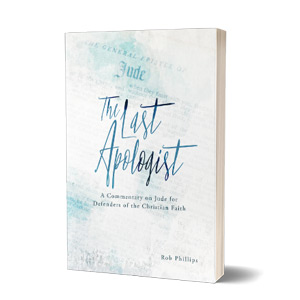
last-apologist-thumbThis is the first in a series of excerpts from “The Last Apologist: A Commentary on Jude for Defenders of the Christian Faith,” available in print and Kindle editions here.


My business card is standard fare. It identifies me and describes my role at the MBC. It also tells how to get in touch with me. That’s what most business cards do: serve as practical, brief, and efficient introductions.

Some people, however, use business cards more creatively. Take Guangbiao Chen, for example, a Chinese tycoon and philanthropist. His business card details illustrious titles and heroic accomplishments:

  • Most Influential Person of China
  • Most Prominent Philanthropist of China
  • China Earthquake Rescue Hero
  • Most Well-Loved and Beloved Chinese Role Model

We’re only halfway through Chen’s list, but you get the idea. This may be one of the cheekiest business cards ever produced.

But how would you respond if someone handed you a business card that simply read, “Jude, a slave”? That’s how the author of the Epistle of Jude opens his letter. With profound humility, he models the manner in which followers of Jesus should defend the Christian faith.
Continue reading


Jesus in the Old Testament

This is the 18th in a series of articles on the Trinity, excerpted from “What Every Christian Should Know About the Trinity,” available through Amazon and other booksellers.

Prophetic portions of the Old Testament anticipate a coming Messiah. While explicit references to his deity are rare, key passages offer clues of the Anointed One’s eternal nature and divine power. 

Isaiah 9:6-7 is one example: “For a child will be born for us, a son will be given to us, and the government will be on his shoulders. He will be named Wonderful Counselor, Mighty God, Eternal Father, Prince of Peace. The dominion will be vast, and its prosperity will never end. He will reign on the throne of David and over his kingdom, to establish and sustain it with justice and righteousness from now on and forever. The zeal of the LORD of Armies will accomplish this.” 

Since the Israelites are strict monotheists, the very idea of “Mighty God, Eternal Father” coming to sit on King David’s throne and rule forever no doubt fuels great wonder and encouragement in God’s people. The name “Mighty God” means more than a godlike person, for the same Hebrew term, El Gibhor, is applied elsewhere in the Old Testament to Yahweh (Isa. 10:21; Jer. 32:18). Isaiah understands that the Messiah is God in the same sense of the term.

As for “Everlasting Father,” Isaiah does not mean to confuse the Father and the Messiah as if they are the same person. Rather, the prophet uses a Jewish idiom to describe the Messiah’s relationship to time, not His relationship with the other members of the Trinity. The Messiah is everlasting, just as God the Father is called the “Ancient of Days” in Daniel 7:9. It is similar to Micah’s messianic prophecy, which declares, “His origin is from antiquity, from ancient times” (Mic. 5:2).

Continue reading

What is the kingdom of heaven?

Excerpted from The Kingdom According to Jesus: A Study of Jesus’ Parables on the Kingdom of Heaven.

—————————————-

The terms kingdom of God, kingdom of heaven, and kingdom (with reference to the kingdom of God/heaven) appear nearly 150 times in Scripture. None of these references gives a simple, straightforward definition of the kingdom, and many passages appear to be contradictory.

Yet the kingdom is the primary focus of Jesus’ teaching. Many of his parables describe the kingdom. The apostles preach the “gospel of the kingdom.” And end-times prophecy points us toward the day when God’s kingdom comes in its fullness.

So, what is the kingdom of heaven? Are the kingdom of heaven and the kingdom of God the same thing? Is the kingdom here already, or are we to wait for it? What does it look like? Who’s in the kingdom and who’s not? And what is required to enter the kingdom?

To begin, we need to understand what the Bible says the kingdom of heaven is—and is not.
Continue reading

God as Father of the church

This is the 17th in a series of articles on the Trinity, excerpted from “What Every Christian Should Know About the Trinity,” available through Amazon and other booksellers.

Let’s consider the wonderful doctrine of God as Father of the church – specifically, as the Father of everyone who receives His Son, Jesus Christ, by faith and thus is adopted into God’s family.

The Bible speaks of adoption as an act of God making born-again believers members of His family. As in first-century Roman culture, all former relationships of the adopted child are severed, and the adoptee is made a full-fledged member of his or her new family under the father’s authority, and with the full privileges and responsibilities of an adult

For Christians, then, no longer does the evil one hold his servants captive, in spiritual blindness, alienated from God, and destined for outer darkness. Christ has come to our rescue, redeeming us from the slave market of sin and joyfully welcoming us into the Father’s family as Jesus’ coheirs in His everlasting kingdom.

Adoption into God’s family is part of the Father’s predestined plan for everyone who believes. It is inextricably bound to all other elements of salvation, spanning from eternity past in foreknowledge to eternity future in glorification. As a consequence, we may rest assured of our salvation, for just as a Roman father could not disown an adopted son, God is faithful to His promise to conform us to the image of His eternal Son.
Continue reading

A verse-by-verse commentary on Jude

The epistle of Jude may be one of the most neglected New Testament books. Bible readers are tempted — in part by its brevity and in part by its similarity to 2 Peter 2 — to skip over Jude on the way to Revelation, or to give this short epistle little more than a glance.

That’s unfortunate, because Jude speaks volumes about the value of Christian apologetics. The Last Apologist: A Commentary on Jude for Defenders of the Christian Faith, is more than a verse-by-verse study. Each chapter explores key words and phrases, and poses thought-provoking questions that make this a handy resource for personal or group study.

Order your soft-cover copy or Kindle version from Amazon.

Last, you might want to check out the short video below.