
Category: Uncategorized
Apologetics 101 at Brentwood Baptist
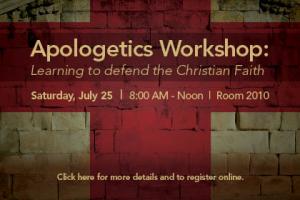
Just a reminder to join us July 25 for Apologetics 101: Learning to Defend the Christian Faith. This workshop will be held from 8 a.m. – noon at Brentwood Baptist Church and will feature four sessions: 1) What is apologetics? 2) How do I know the Bible is true? 3) Who’s the real Jesus? And 4) How can I counter false teachings? There is no charge but attendees are asked to register online.
Apologetics Workshop Coming to Brentwood Baptist
 Newsweek magazine recently reported that “the Christian God … is less of a force in American politics and culture than at any other time in recent memory.” Christianity, it seems, is weathering unprecedented attacks from outside the church. Yet there’s evidence it also is crumbling from within as many Christians, impacted by Western culture, prefer emotional experience and entertainment to sound doctrine. For Christians, there has never been a more important time to know what we believe, why we believe, and how to share our faith with an increasingly skeptical – and lost – world.
Apologetics 101 provides a basis for learning to defend the Christian faith. This introductory workshop at Brentwood Baptist Church will feature four sessions: 1) What is apologetics? 2) How do I know the Bible is true? 3) Who’s the real Jesus? And 4) How can I counter false teachings? The workshop will be held from 8 a.m. to noon on Saturday, July 25, in the Connection Center Room 2010. The café will be open at 7:30 a.m. and offer lunch at noon. Facilitating the workshop is Rob Phillips, an apologetics instructor certified by the North American Mission Board.
Be Ready Always
 Many thanks to Pastor Paul Rummage and the people of Bartlesville (Okla.) Southern Baptist Church for hosting “Be Ready Always: An Apologetics Workshop” May 2-3. I am so grateful for the opportunity I had to return to my “home church” where 25 years ago the people there loved me into the kingdom of heaven and gave me the privilege to serve as deacon and associate pastor. Great attendance for all five sessions — a clear marker of the church’s spiritual depth and evangelistic heart.
For those unable to attend, I am attaching the workbook of supplementary materials. Special thanks to Debbie Strobel for building the workbooks; to Mike and Vickie Benzin for their hospitality (and introducing me to NHL hockey in high-definition TV); to Paula Young for the photographs; and to everyone who invested their time in a weekend of in-depth study. May the Lord bless you all!
Jesus in the Feasts of Israel
The Jewish celebration of Passover begins today [April 8] at sundown and is the first of seven major feasts. The feasts of Israel are religious celebrations remembering God’s great acts of salvation in the history of His people. The term “feasts” in Hebrew literally means “appointed times” and in Scripture the feasts often are called “holy convocations.” They are times God has appointed for holy purposes.
While there are many religious celebrations in Jewish history and custom, seven are most significant: Passover, Unleavened Bread, First Fruits, Pentecost, Trumpets, Day of Atonement and Tabernacles. God established the timing and sequence of these feasts to reveal to us a special story — the work of the Messiah in the redemption of mankind and the establishment of His kingdom on earth.
To learn more, click here or download a free study.
Isaiah 15-20: Chapter Summaries
Since I’m traveling this week, there are no notes or audio files for our study of Isaiah, but I hope you’ll find the chapter summaries from the last six weeks helpful. Next week: Isaiah 21.
Chapter 15: The Waters are Full of Blood
God raised up nations like Moab to be the instruments of His judgment against His people (see Isa. 5:26-30; 7:18-20). These nations have gone beyond God’s boundaries in punishing Israel. Therefore, God will bring them down.
Everyone can see the natural course of godless nations by observing key events in the history of Moab: 1) Moab’s rise; 2) Moab’s rebellion; 3) God’s retribution.
Chapter 16: An Object of Contempt
Arriving in Edom, the Moabite refugees should turn to God through their neighbor Israel, but in pride they refuse to do so. As a result, the fruitfulness of their land will cease.
Everyone can see the futility of godless nations by observing Moab’s reactions to the Assyrian invasion: 1) Moab’s plea for Judah’s protection; 2) Moab’s pride in rejecting Judah’s God.
Chapter 17: Partners in Crime
J. Vernon McGee writes: “Because of the confederacy between Syria and Israel (often for the purpose of coming against Judah), Israel is linked with the judgments pronounced on Syria. Partners in crime means partners in judgment” (Isaiah Volume 1, p.137).
Everyone should learn to trust God because of His mighty deeds among the nations: 1) He plunders the wicked; 2) He protects His own; 3) He punishes for a purpose.
Chapter 18: Left for the Birds of Prey
The land of Cush is told not to move frantically by boat or other means to secure alliances against Assyria, for the Lord will deal directly with the Assyrians and leave their corpses to the birds of prey.
Everyone can understand the Lord’s message to Cush by answering four questions: 1) Who are these people? 2) What have they done? 3) How will God respond? 4) What is their ultimate destiny?
Chapter 19: Egypt’s Heart will Melt
D.A. Carson summarizes: “This oracle is a strong expression of the truth that God smites in order to heal (see v 22). The initial breakdown is followed by a renewal which goes beyond anything promised to a Gentile nation in the O.T. Perhaps Egypt is shown here in its two aspects: first, as the worldly power to which Israel was always looking (cf. 20:5) and secondly, as part of God’s world, for which he cares, with a place in his kingdom in which present ranks and races will be quite superseded” (New Bible Commentary : 21st Century Edition, S. Is 18:1).
Everyone can see God’s redemptive work in humanity by observing two ways He deals with Egypt: 1) He hits them where they hurt; 2) He heals them when they hear.
Chapter 20: Naked and Barefoot
The Lord commands Isaiah to walk naked and barefoot among the Jews for three years as a warning not make the same mistake Ashdod made in trusting the Egyptians for protection against the invading Assyrians. If they do, they will be defeated and marched naked and barefoot into captivity.
Everyone should understand Isaiah’s “sign act” because of the truths it conveys: 1) What man determines, God destroys; 2) what God determines, man cannot defeat.
Copyright 2009 by Rob Phillips
 OnceDelivered.net