
Tagged: Apologetics
Apologetics 101: Download Notes
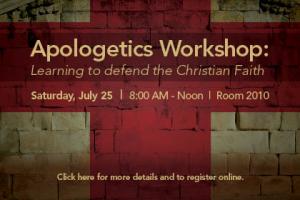 Thanks to everyone attending Apologetics 101: Learning to Defend the Christian Faith at Brentwood (Tenn.) Baptist Church this weekend. As promised, I am making the notes available as a free download in pdf format. You are welcome to copy and share these notes in electronic or print format but, as with all resources on this Web site, please do not alter the contents or charge for their use.
Download: Apologetics 101: Learning to Defend the Christian Faith
Apologetics 101 at Brentwood Baptist
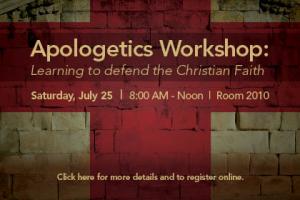
Just a reminder to join us July 25 for Apologetics 101: Learning to Defend the Christian Faith. This workshop will be held from 8 a.m. – noon at Brentwood Baptist Church and will feature four sessions: 1) What is apologetics? 2) How do I know the Bible is true? 3) Who’s the real Jesus? And 4) How can I counter false teachings? There is no charge but attendees are asked to register online.
Apologetics Workshop Coming to Brentwood Baptist
 Newsweek magazine recently reported that “the Christian God … is less of a force in American politics and culture than at any other time in recent memory.” Christianity, it seems, is weathering unprecedented attacks from outside the church. Yet there’s evidence it also is crumbling from within as many Christians, impacted by Western culture, prefer emotional experience and entertainment to sound doctrine. For Christians, there has never been a more important time to know what we believe, why we believe, and how to share our faith with an increasingly skeptical – and lost – world.
Apologetics 101 provides a basis for learning to defend the Christian faith. This introductory workshop at Brentwood Baptist Church will feature four sessions: 1) What is apologetics? 2) How do I know the Bible is true? 3) Who’s the real Jesus? And 4) How can I counter false teachings? The workshop will be held from 8 a.m. to noon on Saturday, July 25, in the Connection Center Room 2010. The café will be open at 7:30 a.m. and offer lunch at noon. Facilitating the workshop is Rob Phillips, an apologetics instructor certified by the North American Mission Board.
Be Ready Always
 Many thanks to Pastor Paul Rummage and the people of Bartlesville (Okla.) Southern Baptist Church for hosting “Be Ready Always: An Apologetics Workshop” May 2-3. I am so grateful for the opportunity I had to return to my “home church” where 25 years ago the people there loved me into the kingdom of heaven and gave me the privilege to serve as deacon and associate pastor. Great attendance for all five sessions — a clear marker of the church’s spiritual depth and evangelistic heart.
For those unable to attend, I am attaching the workbook of supplementary materials. Special thanks to Debbie Strobel for building the workbooks; to Mike and Vickie Benzin for their hospitality (and introducing me to NHL hockey in high-definition TV); to Paula Young for the photographs; and to everyone who invested their time in a weekend of in-depth study. May the Lord bless you all!
Isaiah 24: The Earth Mourns and Withers
Listen to “The Earth Mourns and Withers” (4.19.09)
Chart: The Tribulation and the Millennium – 4 Views
Prologue
Where we are:
|
Part 1: Judgment |
Part 2: Historical Interlude |
Part 3: Salvation |
|
Chapters 1-35 |
Chapters 36-39 |
Chapters 40-66 |
When this takes place:
Isaiah 24-27 forms a single prophecy. While it’s difficult to pinpoint the time in which it is given, it seems best to place it a short time before the attack by Sennacherib, king of Assyria, on Jerusalem in 701 B.C.
Key verses:
Isa. 24:21-22 – On that day the Lord will punish the host of heaven above and kings of the earth below. They will be gathered together like prisoners in a pit. They will be confined to a dungeon; after many days they will be punished.
Quick summary:
This section of Isaiah begins with an end-times perspective explaining how the Lord will judge the whole world and set up His kingdom on earth (Isa. 24:1-3, 19-23). “These prophecies reveal how God will finally deal with the rebellious nations of chaps. 13-23 so that he can bring an end to the pride and violent sinfulness that has polluted the earth. God will destroy the wicked and establish peace on the earth, and then the holy people who remain will worship God alone and sing songs to exalt him” (Gary V. Smith, The New American Commentary: Isaiah 1-39, p. 405). Because of their description of the Tribulation and Millennium, chapters 24-27 are known as “Isaiah’s apocalypse.”
Take note:
Notice Isaiah’s description of end-time events that are reinforced in New Testament prophecies. For example, the earth will be stripped completely bare and its inhabitants scattered (vv. 1-3; cf. Rev. 8:6 – 9:21), and the sun and moon will darken in preparation for the full revelation of Messiah’s kingdom (v. 23; cf. Matt. 24:29-30; Rev. 21:23).
The Tribulation (Isa. 24:1-13, 16b-22)
While the immediate context of this chapter may refer to the Assyrian invasion of Judah, or to the Babylonian captivity that will occur more than 100 years later, it seems to have its ultimate fulfillment in the Great Tribulation yet to come. H.L. Willmington offers the following observations:
A. The Great Tribulation–what it is (24:1-4, 6-13, 16b-22)
1. God himself will lay waste to the entire earth (24:1): The earth will become a great wasteland, and the people will be scattered.
2. All people and fallen angels will be judged (24:2-4, 21-22): No one will be spared from God’s wrath, and the fallen angels will be put in prison.
3. Very few will survive (24:6): A curse will consume the earth and its people, who will be destroyed by fire.
4. Happiness will no longer exist (24:7-13): All joy in life will be gone.
5. Evil and treachery will be everywhere (24:16b-18): People possessed by sheer terror will flee from one danger only to be confronted with something even more horrifying.
6. The earth will stagger like a drunkard (24:19-20): It will fall and collapse like a tent, unable to rise again because of the weight of its sins.
B. The Great Tribulation–why it occurs (24:5): Humanity has twisted the laws of God and has broken his holy commands (The Outline Bible, S. Is 24:5).
Isaiah uses the word “earth” 16 times in this chapter to emphasize the global impact of God’s intervention in human affairs, wielding judgment and exalting His glory. No stratum of society is spared and no portion of the earth escapes unscathed. The reason for God’s plundering of the earth is provided in verse 5: “The earth is polluted by its inhabitants, for they have transgressed teachings, overstepped decrees, and broken the everlasting covenant.” That covenant “probably refers not to the Abrahamic or Mosaic Covenants but to the covenant people implicitly had with God to obey His Word. Right from the very beginning mankind refused to live according to God’s Word (Gen. 2:16-17; 3:1-6; cf. Hosea 6:7). And throughout history people have refused to obey God’s revelation” (John F. Walvoord, Roy B. Zuck, The Bible Knowledge Commentary: An Exposition of the Scriptures, S. 1:1072). Robert B. Hughes and Carl J. Laney add, “The ‘everlasting covenant’ must refer to the moral law of God revealed in his word and written in man’s heart (cf. Rom. 2:14-15)” (Tyndale Concise Bible Dictionary, S 263).
It cannot be emphasized too strongly that God is the one wreaking havoc on the earth. While people are responsible for their sinful actions, and these actions often produce great hardship for the perpetrators and for others in the process, the Lord of Hosts clearly is demonstrating His holiness and power in events that otherwise might be interpreted as a scorched-earth policy. After all, if God created the present heavens and earth out of chaos (Gen. 1:2) and judged the earth by water in the great flood (Gen. 6-9), He has every right to judge mankind’s sin in the latter days by reintroducing chaos to the created order. Ultimately, He will purge the heavens and earth of the last vestiges of sin by fire and create new heavens and a new earth (2 Peter 3:5-13; Rev. 21-22). Even the imagery of Isaiah in verse 18 harkens back to the flood: “For the windows are opened from above, and the foundations of the earth are shaken” (cf. Gen. 7:11).
Matthew Henry summarizes well:
The Lord that made the earth, and made it fruitful and beautiful, for the service and comfort of man, now makes it empty and waste (v. 1), for its Creator is and will be its Judge; he has an incontestable right to pass sentence upon it and an irresistible power to execute that sentence. It is the Lord that has spoken this word, and he will do the work (v. 3); it is his curse that has devoured the earth (v. 6), the general curse which sin brought upon the ground for man’s sake (Gen. 3:17), and all the particular curses which families and countries bring upon themselves by their enormous wickedness. See the power of God’s curse, how it makes all empty and lays all waste; those whom he curses are cursed indeed (Matthew Henry’s Commentary on the Whole Bible: Complete and Unabridged in One Volume, S. Is 24:1).
One final note should be made before moving on. Isaiah writes that the Lord will punish “the host of heaven above and the kings of the earth below” (v. 21). The “host of heaven” may refer to the spiritual forces opposed to God, specifically Satan and demons. The “kings of the earth below” no doubt are the earthly political forces facing God’s judgment. “Those powers in the heavens and on the earth will become like cattle when the Lord herds them together and places them like prisoners . . . in a dungeon. Their punishment after many days refers to the great white throne judgment after the Millennium when all the unrighteous will have to stand before God and be judged for their evil deeds and lack of faith in Him (Rev. 20:11-15)” (The Bible Knowledge Commentary, S. 1:1072).
The Promised Kingdom (Isa. 24:14-16a, 23)
A few will escape these terrible judgments, just as a few olives or grapes may be gleaned after the harvest (v. 13). The survivors will rejoice, raising their voices in songs of praise that may be heard from “the ends of the earth” (v. 16). This singing seems to come out of the scattered remnant, which in the light of the gospel may be seen as Jews and Gentiles alike (cf. John 11:52). “Out of this terrible devastation … will come the glorious light of Christ in his millennial kingdom (24:23; see 60:19-20; Rev. 21:23; 22:5)” (Willmington’s Bible Handbook, S. 365). If the sun and moon are to lose their luster in comparison with the Messiah, what a surpassing vision of glory awaits all who trust in Him (see Rev. 21:22-27).
It’s important to keep in mind that the concept of a remnant is central to Isaiah’s teaching (see Isa. 1:9; 10:20-22; 11:11, 16; 14:22, 30). The believing remnant will view the earth’s devastation as the righteous act of a holy God; it will not be viewed in the way the people of Isaiah’s day see the Assyrian invasion – as cruel and unjust punishment. Those who receive Christ by faith today may joyfully anticipate His future physical and visible manifestation of power, glory and holiness.
Closing Thought
Matthew Henry writes: “Those who through grace can glory in tribulation ought to glorify God in tribulation, and give him thanks for their comforts, which abound as their afflictions do abound. We must in every fire, even the hottest, in every isle, even the remotest, keep up our good thoughts of God. When, though he slay us, yet we trust in him-when, though for his sake we are killed all the day long, yet none of these things move us-then we glorify the Lord in the fires” (S. Is 24:13).
Copyright 2009 by Rob Phillips
 OnceDelivered.net