Why the world is broken

Nearly everyone admits the world is broken, at least to some extent. There’s a disconnect between “what is” and “what ought to be.”
People pursue happiness, only to die sad and alone.

Our stuff wears out, loses its luster, or gets stolen.

Buses run late, baristas can’t make a decent latte, and the wrong team wins the Super Bowl.

Worse, evil runs rampant. ISIS bombs innocent concert-goers. Governments starve their people, even in resource-rich countries. Twitter wars trash reputations.

And on it goes. When we stop to ask our friends why they believe the world is broken, we get a variety of opinions.
Continue reading

Jude, A Slave: The Attitude of Apologetics


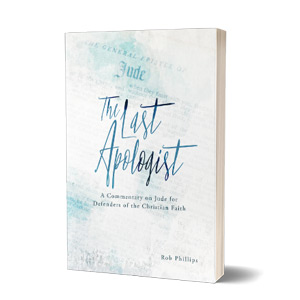
The Missouri Baptist Convention has published a new resource called The Last Apologist: A Commentary on Jude for Defenders of the Christian Faith. The 275-page book is available in print and Kindle editions on Amazon, and in print from the MBC. But we also want to make each of the 16 chapters available online. This post features Chapter 1: Jude, A Slave: The Attitude of Apologetics.

Previously: Introducing The Last Apologist


Jude, a slave of Jesus Christ … (Jude 1a)

My business card is standard fare. It identifies me and describes my role at my place of employment. It also offers several ways to get in touch with me. That’s what most business cards do; they serve as practical, brief, and efficient introductions.

Some people, however, use business cards more creatively, with pop-up photos, odd shapes, and other features to grab your attention. And then there are truly unique characters who seek to leave a lasting impression another way: by making audacious claims.

Take Guangbiao Chen, for example. Chen is a Chinese tycoon and philanthropist. His business card details illustrious titles and heroic accomplishments. For example, his English business card describes him in the following ways:

  • Most Influential Person of China
  • Most Prominent Philanthropist of China
  • China Moral Leader
  • China Earthquake Rescue Hero
  • Most Well-Loved and Beloved Chinese Role Model

We’re only halfway through Chen’s list, but you get the idea. This may be one of the cheekiest business cards ever produced.

But how would you respond if someone handed you a business card that simply read, “Jude, a slave …”? Let’s see how Jude’s profoundly humble self-introduction models the manner in which followers of Jesus should defend the faith.
Continue reading

What Christians can learn from the cults

Counterfeit forms of Christianity — most notably Mormonism and the Jehovah’s Witnesses — thrive on deception.
This is nothing new. The apostle Paul warned the Corinthians about false prophets who proclaimed “another Jesus … a different Spirit … a different gospel” (2 Cor. 11:4).

While Christians should seek to correct the false doctrines of our Mormon and Jehovah’s Witness friends, we might also consider learning from their admirable qualities, including:

(1) Their zeal for witnessing. Mormons and Jehovah’s Witnesses believe they have recaptured true Christianity after centuries of apostasy. They not only stand behind their convictions; they put feet to them.

Today, there are nearly 71,000 Mormon missionaries carrying the message of Joseph Smith around the world — at their own expense, or the expense of their families. Meanwhile, Jehovah’s Witnesses boast 8.3 million “publishers” in 240 countries.

They may be faulted for their false teachings, but certainly not for their faithfulness to them.

As Anthony Hoekema has written in The Four Major Cults, “It would appear that the cults are generally pursuing a much more diligent and systematic program of witnessing, both at home and abroad, than are the churches.”
Continue reading

Introducing “The Last Apologist”

The Missouri Baptist Convention recently published a new resource called The Last Apologist: A Commentary on Jude for Defenders of the Christian Faith. The 275-page book is available in print and Kindle editions on Amazon, and in print from the MBC. But we also want to make each of the 16 chapters available online. So, this post introduces the study, and then in the weeks to come we are posting The Last Apologist one chapter at a time, or, in some cases, one portion of a chapter at a time. We pray that it is a help and encouragement to you.


Continue reading

How to make a universe

This is the second in a two-part series on Stephen Hawking’s contention that science has resolved the need for God.

In the previous column, we examined the logical fallacies theoretical physicist Stephen Hawking employs in the Discovery Channel series, “Stephen Hawking’s Grand Design.”

Now, let’s turn our attention to how a universe is made. While Scripture tells us that God spoke the world into existence (Gen. 1:3-26; Ps. 33:9; Heb. 11:13), Hawking contends that nothing more than matter, energy, and space is needed to craft a universe.

But where did these ingredients come from? The Bible describes the creative act of God as ex nihilo — out of nothing. The eternally existing God created everything, visible and invisible, as an act of divine will.

Science tells quite a different tale than the biblical account, according to Hawking: “We can use the laws of nature to grasp the very origins of the universe and discover if the existence of God is the only way to explain it.”

A universe may materialize out of nothing through purely natural processes, he says. The laws of physics demand the existence of something called “negative energy.”

When the Big Bang produced vast amounts of positive energy, it also produced an equal amount of negative energy, says Hawking.

So, where is all the negative energy today? In space, he says. Space is a vast storehouse of negative energy, ensuring that all positive and negative energy adds up to zero.
Continue reading