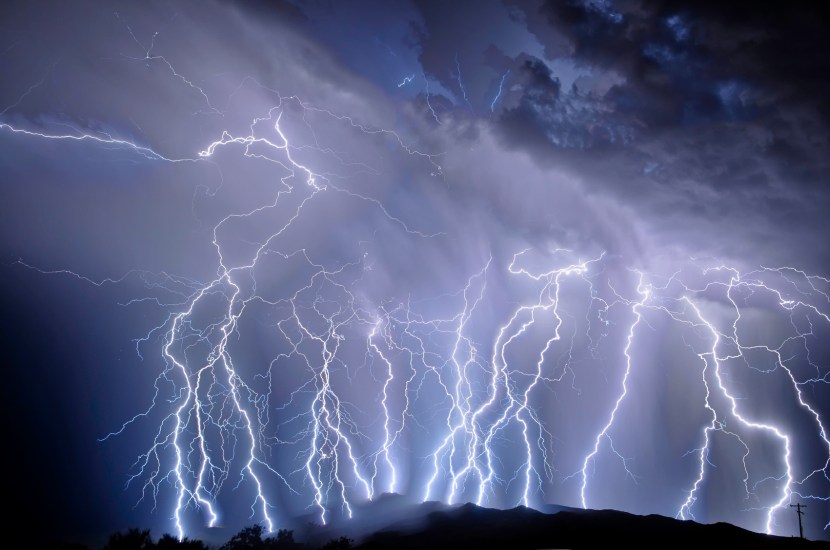
A great white throne – Revelation 20:11
Previously: The lake of fire – Revelation 20:10

The scripture

Rev. 20:11 – Then I saw a great white throne and One seated on it. Earth and heaven fled from His presence, and no place was found for them.  (HCSB)

A great white throne

In contrast to the heavenly “thrones” upon which people sit and from which they are given authority to rule (verse 4), John now describes “a great white throne” upon which God sits to judge the wicked standing before Him. Specifically, the One seated on the throne is Jesus, to whom the Father has given all judgment (John 5:22). John describes the throne as great and white to indicate the purity of Christ and the awesome weight His judgments carry.

John sees a similar throne in heaven in Revelation 4, but the circumstances are vastly different.

The One seated on the throne in Revelation 4 is surrounded by a rainbow, indicative of God’s covenant promises; but the throne in Revelation 20 is stark and singular, for there are no further hopes to fulfill.

The throne in Revelation 4 is surrounded by 24 elders that cast their crowns before Him and declare His worthiness; but the throne in Revelation 20 stands alone, for there is no reward to share with the wicked standing there, and no praise from their lips.

The throne in Revelation 4 features lightning and thunder as warnings of God’s power and as invitations to repent; but the throne in Revelation 20 is silent and eerily calm, for the end of grace has come.

The throne in Revelation 4 witnesses the seven-fold Spirit of God, which bears testimony of Christ and woos people to turn to Him for salvation; but the throne in Revelation 20 has no flaming torches and no still, small voices.

The throne in Revelation 4 has before it a glassy sea to indicate heavenly peace and security; but the throne in Revelation 20 is barren of such harbors because the wicked have rejected the Person who offers them peace.

The throne in Revelation 4 receives thunderous praise and joyful exultation from heavenly creatures and redeemed people; but the throne in Revelation 20 receives only silence because the ones standing before it have no praise to give and no defense to offer.

There is something stark and terrifying about the throne in Revelation 20, as we are about to discover.
Continue reading

Has the gospel been corrupted?

a bible in a dark over wooden tableMuslims believe in the Injil, or gospel, but define it differently than evangelical Christians do. Further, they claim the church has corrupted the biblical texts so that only the Qur’an preserves the genuine good news.

In defining the gospel, Muslim commentator Yusuf Ali writes that “the Injil spoken of by the Qur’an is not the New Testament. It is not the four Gospels now received as canonical. It is the single Gospel which, Islam teaches, was revealed to Jesus, and which he taught.”

In other words, the gospel is the prophetic teaching of Jesus as captured in the Qur’an, directing all people to submit to the will of Allah.

Further, Muslims argue that Christians have altered the New Testament texts, resulting in doctrinal errors such as the deity of Christ, the Trinity, and original sin.

But a careful look at the Qur’an shows that Islam’s most holy book affirms the inspiration, preservation, and authority of the Gospel record. At the same time, it exposes the inconsistency of Muslim teachings about the Bible.
Continue reading

The lake of fire – Revelation 20:10

Save us from the fire

Previously:  Fire came down from heaven – Revelation 20:9

The scripture

Rev. 20:10 – The Devil who deceived them was thrown into the lake of fire and sulfur where the beast and the false prophet are, and they will be tormented day and night forever and ever. (HCSB)

The lake of fire

At last we come to the end of the father of lies. John records, “The Devil who deceived them was thrown into the lake of fire and sulfur where the beast and the false prophet are, and they will be tormented day and night forever and ever” (v. 10). The lake of fire and sulfur is, of course, hell, or gehenna in the Greek. The name is drawn from the Valley of the Son of Hinnom just outside Jerusalem, a place where apostate Israelites in Old Testament times sacrifice their children to the pagan god Moloch. Hell is a place of conscious existence where Satan, demons and the wicked spend eternity apart from Christ.

This passage should be seen in light of Rev. 14:9-11, which describes the destiny of the one who worships the beast: “he will also drink the wine of God’s wrath, which is mixed full strength in the cup of His anger. He will be tormented with fire and sulfur in the sight of the holy angels and in the sight of the Lamb, and the smoke of their torment will go up forever and ever. There is no rest day or night for those who worship the beast and his image, or anyone who receives the mark of his name.”

Jesus calls hell “the eternal fire prepared for the Devil and his angels” (Matt. 25:41). People who reject God’s gracious offer of eternal life join Satan and his demons in the lake of fire. Jesus also calls hell “outer darkness” where there is weeping and gnashing of teeth. It is place where the worm does not die and the fire is never quenched, meaning that the resurrected bodies of unbelievers do not die and are not annihilated.

Hell is a place to be avoided at all costs, yet a place where no person or demon goes beyond his or her will. As C.S. Lewis famously wrote, “There are two kinds of people: those who say to God, ‘Thy will be done,’ and those to whom God says, ‘All right, then, have it your way.’”
Continue reading

Fire came down from heaven – Revelation 20:9

Lightning over the Rincon Mountains

Previously: Satan will be released – Revelation 20:7-8

The scripture

Rev. 20:9 – They came up over the surface of the earth and surrounded the encampment of the saints, the beloved city. Then fire came down from heaven and consumed them. (HCSB)

Then fire came down from heaven

“They” in verse 9 are the armies of Satan, which surround Jerusalem. But fire descends from heaven and consumes them. We have seen references to heavenly fire in other passages:

  • The Lord sends burning sulfur to destroy the wicked inhabitants of Sodom and Gomorrah (Gen. 19).
  • Fire comes down from heaven to consume a burnt offering, its wood and stones, and even a trench of water around it in the days of Elijah as he squares off against the false prophets of Baal (1 Kings 18).
  • Fire again rains down from heaven on several occasions to destroy the messengers sent to Elijah by King Ahaziah (2 Kings 1).
  • James and John ask Jesus for permission to call down fire from heaven on a Samaritan village that rejects the Messiah, but He rebukes His followers and leads them to another place (Luke 9:51-55).
  • The two witnesses in Revelation 13 are able to call down fire from heaven.
  • And here in Revelation 20 fire destroys the enemies of God.

Fire often is a sign of the presence of God and highlights His purity, holiness, and wrath.

Continue reading

Biblical truth and LDS deity

Do Christians and Mormons worship the same God?

The question may irk our LDS friends, who insist that the Church of Jesus Christ of Latter-day Saints is the restored Church and therefore cannot be distinguished from orthodox Christianity.

What’s more, some LDS leaders shrewdly blur the lines that separate Mormon beliefs from the biblical doctrines evangelicals affirm – sometimes with the help of evangelicals in the name of “dialogue.”

A case in point: How Wide the Divide? – a book by Brigham Young University’s Stephen Robinson and Denver Seminary professor Craig Blomberg.

While both scholars argue their distinct theological views, they acknowledge agreements such as, “The Father, the Son, and the Holy Spirit are one eternal God.”

Really? Is the doctrine of God true common ground for evangelicals and Mormons? Not so fast.
Continue reading