
Category: Uncategorized

Seven promises in Revelation 22 (Conclusion)
 There are at least seven promises given to us in Revelation 22 that confirm Jesus’ victory over Satan, sin and death. These promises also assure us that all the effects of the Fall are reversed in Christ’s finished work and the salvation He has provided for us by grace through faith.
In the previous post, we looked at promises 1-4. We conclude our brief survey now.
Promise No. 5: Light (v. 5)
Before creation there was darkness (Gen. 1:2), but God, who is light, brought light into the universe. Just as darkness is the absence of light, so evil is depicted in Scripture as darkness because it is an absence – perhaps more accurately, a shunning – of God’s holy presence. Eternal separation from God is called “outer darkness” (Matt. 8:12).
While Jesus suffered the wrath of God for the sins of the world there was darkness over the whole land (Mark 15:33). Unbelievers love darkness rather than light because their deeds are evil (John 3:19). Jesus came to deliver us from darkness (John 12:46). Darkness is associated with Satan and his kingdom (Acts 26:18; Rom. 13:12; Col. 1:13).
But in the New Jerusalem there is abundant light; in fact, there is no need of the sun, moon or stars, or of any artificial light, because God provides light for us. Why is this light promised to us? Because Jesus is the light of the world (John 8:12).
Continue reading
Seven promises in Revelation 22 (Part 1)
 There are at least seven promises given to us in Revelation 22 that confirm Jesus’ victory over Satan, sin and death. These promises also assure us that all the effects of the Fall are reversed in Christ’s finished work and the salvation He has provided for us by grace through faith.
In this regard, we should view Revelation not merely as a book of frightening – and often confusing – imagery, but as a book of warm and assuring promises about God’s sovereignty over human affairs and angelic conflict. In the end, we who read, hear and heed the words of this prophecy are indeed blessed because we know the God who created all things is faithful.
Promise No. 1: Living water (v. 1; see also Rev. 21:6; 22:17)
There was a river in the Garden of Eden (Gen. 2:10) that served as the source of four other rivers. But when Adam and Eve were banished from the Garden they lost access to this pure source of water and drank from streams now affected by the Fall. A person may live for up to 40 days without food but only three days without water. The body itself is made up largely of water, so water is essential to life. Jesus often spoke about water as an image of eternal life supplied by the Holy Spirit (see John 4:10-14; 7:37-39).
In the New Jerusalem, we see a river of pure, living water flow from the throne of God and of the Lamb, and all whose names are written in the Lamb’s book of life may drink freely from it. Ezekiel also had a vision of pure water in the glorious future temple (Ezek. 47:1-12; see also Zech. 14:8). This living water depicts the Holy Spirit who inhabits the human spirits of believers but is cut off from unbelievers (Rom. 8:9).
Continue reading

Jesus Before Bethlehem: Join the webcast
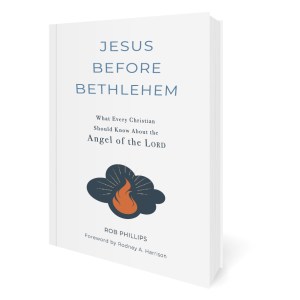 Our newest resource from High Street Press is Jesus Before Bethlehem: What Every Christian Should Know about the Angel of the LORD. It’s being featured today (July 7) in a webcast from Midwest Christian Outreach, hosted by president Don Veinot.
The one-hour webcast begins at noon Central Daylight Time. To learn more about the book, Midwest Outreach, or to join the webcast, click here.

A look into Gehenna
 The ultimate destiny of the wicked is the same habitation created for Satan and his demons – a place in English we call “hell,” and a place Jesus and the New Testament writers describe variously as Gehenna, “outer darkness,” “eternal fire,” “eternal punishment,” “lake of fire,” and “the second death.”
While Sheol and Hades generally depict the temporary abode of the dead, Gehenna and its associated terms describe the place of everlasting future punishment for those whose names are not written in the book of life (Rev. 20:15).
The term Gehenna is derived from the Valley of Hinnom. Located southwest of Jerusalem, this steep, rocky valley is the scene of human sacrifices to pagan deities (2 Kings 23:10; 2 Chron. 28:3; 33:6) and is declared the “Valley of Slaughter” by Jeremiah (Jer. 7:31-34).
The picture of a place where fires are never quenched and worms never stop feasting on corpses became to the Jewish mind an appropriate representation of the ultimate fate of idol worshipers.
Continue reading
A look into Tartarus
 If Sheol or Hades is the temporary abode of deceased people, is there a transitory place of punishment for some demons?
It seems the answer is yes, in a place the New Testament refers to as Tartarus.
Tartarus is mentioned only once, in 2 Peter 2:4. Many translations render it “hell,” including the King James Version and the New American Standard Bible, while others, like the English Standard Version and the New International Version, provide footnotes linking the English word “hell” to the Greek name Tartarus.
The Holman Christian Standard Bible simply transliterates the Greek word in this passage, which reads: “For if God did not spare the angels who sinned, but threw them down into Tartarus and delivered them to be kept in chains of darkness until judgment …”
A footnote in the HCSB reads: “Tartarus is a Greek name for a subterranean place of divine punishment lower than Hades.”
In the apocryphal Book of 1 Enoch (20:2), Tartarus is used as a place where fallen angels are punished, an interpretation Peter affirms.
So, Tartarus seems to be a place separate from Sheol, the Hebrew term for the abode of the dead; Hades, roughly the Greek equivalent of Sheol; and Gehenna, the lake of fire created for the Devil and his angels (Matt. 25:41) where wicked people also spend eternity (Rev. 20:15).
Ancient Greeks regarded Tartarus as a place where rebellious gods and other wicked ones are punished. Peter refers to Tartarus as the abode of certain fallen angels.
Continue reading
 OnceDelivered.net