
Category: Kingdom of Heaven
Why Jesus used parables to describe the kingdom
Following is chapter 2 of The Kingdom According to Jesus. You may order the entire study from a number of the nation’s leading booksellers.
Matt. 13:10-17, 34-35 (HCSB)
10 Then the disciples came up and asked Him, “Why do You speak to them in parables?”
11 He answered them, “Because the secrets of the kingdom of heaven have been given for you to know, but it has not been given to them.
12 For whoever has, [more] will be given to him, and he will have more than enough. But whoever does not have, even what he has will be taken away from him.
13 For this reason I speak to them in parables, because looking they do not see, and hearing they do not listen or understand.
14 Isaiah’s prophecy is fulfilled in them, which says: You will listen and listen, yet never understand; and you will look and look, yet never perceive.
15 For this people’s heart has grown callous; their ears are hard of hearing, and they have shut their eyes; otherwise they might see with their eyes and hear with their ears, understand with their hearts and turn back— and I would cure them.
16 But your eyes are blessed because they do see, and your ears because they do hear!
17 For I assure you: Many prophets and righteous people longed to see the things you see yet didn’t see them; to hear the things you hear yet didn’t hear them.”
34 Jesus told the crowds all these things in parables, and He would not speak anything to them without a parable,
35 so that what was spoken through the prophet might be fulfilled: I will open My mouth in parables; I will declare things kept secret from the foundation of the world.
 What is a parable?
A parable is a story drawn from everyday experience to illustrate a deeper truth – in Scripture, a spiritual truth. The teaching of parables goes back to antiquity. The first parable recorded in the Bible is that of the trees choosing for themselves a king (Judges 9:7-15). There are numerous parables in both the Old and New Testaments, but the most common parables are those taught by Jesus. While Jesus was not the first to use parables, He endowed them with unparalleled originality and spiritual depth. In fact, more than one-third of all His recorded sayings are parables.
Two Greek words are translated “parable” in the New Testament: parabole (48 times), meaning “to represent or stand for something,” and paroimia (four times in John), meaning “an adage, dark saying, proverb, a presentation deviating from the usual means of speaking.” As Herbert Lockyer writes in All the Parables of the Bible, “Parables prove that the external is the mirror in which we may behold the internal and the spiritual.” Parables also reward the faithful learner. As Matthew Henry writes in his unabridged commentary, “A parable is a shell that keeps good fruit for the diligent, but keeps it from the slothful.”
Parables and the mystery of the kingdom
Many of Jesus’ parables describe “the mystery/secret of the kingdom of God” (Mark 4:11). The term “mystery” means something God has held in secret throughout the ages but has finally disclosed in a new revelation of His redemptive work. In this case, the mystery of the kingdom is that God’s kingdom has come in an unexpected way – a way not fully revealed in the Old Testament.
With the coming of Jesus the Messiah as the Lamb of God, or the Suffering Servant, He invades Satan’s kingdom and reigns in the hearts of men. Yes, the day will come when God’s kingdom overcomes human authority, when the Lion of Judah appears in power and great glory to sit on the throne of David and rule the earth, but first He must come humbly and lay down His life as a ransom for lost sinners, destroying the enemies of God: sin, Satan and death. Jesus uses parables to reveal these previously hidden truths about the kingdom.
George Eldon Ladd puts it this way in The Gospel of the Kingdom: “But the mystery, the new revelation, is that this very Kingdom of God has now come to work among men but in an utterly unexpected way. It is not now destroying human rule; it is not now abolishing sin from the earth; it is not now bringing the baptism of fire that John had announced. It has come quietly, unobtrusively, secretly. It can work among men and never be recognized by the crowds. In the spiritual realm, the Kingdom now offers to men the blessings of God’s rule, delivering them from the power of Satan and sin. The Kingdom of God is an offer, a gift which may be accepted or rejected. The Kingdom is now here with persuasion rather than with power.” (p. 55).
Why Jesus used parables
In Matthew 13, after Jesus tells the parable of the sower, His disciples ask Him why He is now employing this form of teaching. His answer is revealing:
- Because the mysteries/secrets of the kingdom have been given to Jesus’ disciples but not to others (v. 11). Jesus would spend three full years with the apostles, teaching them about the necessity of His death, burial and resurrection. Others would be taught the mystery in parables and, if they inclined their hearts toward God, would understand.
- Those who received the gospel of the kingdom would benefit from the truths revealed in Jesus’ parables, while those who insisted on a political and military Messiah would no longer be entrusted with the Scriptures – a reference to the Jewish religious leaders (v. 12).
- Those who already are rejecting Jesus as Messiah are so hard of heart they cannot understand these simple parables. Just as the Jews in Isaiah’s days had rejected God – leading to judgment – so the unbelieving Jews of Jesus’ day would face judgment in the destruction of the Temple in 70 A.D., as well as judgment after the kingdom comes in power (vv. 13-15). As Matthew Henry has written, “A parable, like the pillar of cloud and fire, turns a dark side towards Egyptians, which confounds them, but a light side towards the Israelites, which comforts them, and so answers a double intention.”
- Jesus’ parables of the kingdom reveal spiritual truths that the prophets of old could only see in shadow form; the apostles should rejoice that they are witnessing the coming of the kingdom in mystery (vv. 16-17).
- Jesus’ parables fulfill prophecy. The psalmist wrote that Messiah would “declare wise sayings; I will speak mysteries from the past” (Ps. 78:2), and that’s exactly what Jesus did (v. 35). See also Deut. 29:29; Rom. 16:25; 1 Cor. 2:7; Eph. 3:9; and Col. 1:26.
How we should study Jesus’ parables of the kingdom
We will study Jesus’ parables of the kingdom by considering:
- Context. We will ask: To whom is Jesus speaking? When? Where? Why? Who else is present? How does this parable compare with other parables and teachings of Jesus, and with other Scriptures?
- Theme. We will locate the central theme. Parables normally focus on a single key point. Jesus’ parables of the kingdom reveal key aspects of His reign.
- Character(s). We will identify the central character or characters and see how he, she, it or they relate to the central theme. We’ll also ask what role the other characters play in the parable.
- Details. We will look at the details of each parable, being careful not to impose unintended meanings.
- Personal application. We will explore what understanding, attitude or action Jesus is demanding of His listeners – and of us.
The design of speaking in parables
According to Barnes’ Notes on the New Testament, Jesus has the following four things in mind as He tells each parable:
1. To convey truth in a more interesting manner to the mind; adding to the truth conveyed the beauty of a lovely image or narrative.
2. To teach spiritual truth so as to arrest the attention of ignorant people, making an appeal to them through the senses.
3. To convey some offensive truth, some pointed personal rebuke, in such a way as to bring it home to the conscience. Of this kind was the parable which Nathan delivered to David (2 Sam. 12:1-7) and many of our Savior’s parables addressed to the Jews.
4. To conceal from one part of his audience truths which he intended others should understand. Thus Christ often, by this means, delivered truths to his disciples in the presence of the Jews, which he well knew the Jews would not understand; truths pertaining to them particularly, and which he was under no obligations to explain to the Jews (see Matt. 13:13-16; Mark 4:33).
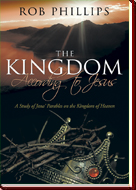
The Kingdom and “Mornings” on FamilyNet

I had the privilege this week to appear on FamilyNet’s “Mornings ” on Sirius Radio to talk about my book, The Kingdom According to Jesus, published by CrossBooks. Many thanks to Lorri Allen and Larry Estepa for having me on the program.
Here’s the audio file, if you’d like to listen in.
“Mornings” — The Kingdom According to Jesus
Why some are cast out of the kingdom
This column first appeared Nov. 3, 2009, in Baptist Press
By Rob Phillips
 One of the more humbling experiences from my days in the corporate world was being told that my reserved seat on the company jet was revoked at the last minute to make room for a late-arriving executive. Not to worry. I was offered the one remaining seat, located in the plane’s lavatory, where the toilet came equipped with a safety belt. Rather than cool my heels on the tarmac, I swallowed my pride and took my place on the porcelain throne.
It reminded me of the parable Jesus told in Luke 14:7-11, rebuking those who reclined at the choicest seats at a wedding banquet. Even more, it brought to mind the future humiliation Jesus said would come to those boasting of a place in the kingdom of heaven, yet being cast out. Though the kingdom is open to all who receive Christ by faith, the day is coming when those who falsely stake their claim to the kingdom will be unceremoniously shown the door.
From Jesus’ own lips, it appears there are at least three types of people who will be cast out of the kingdom of heaven:
1. Those that trust their lineage. In Jesus’ day there was great expectation the Messiah would come – a charismatic military and political leader who would restore Israel to its Davidic glory. Overlooking the necessity of the Suffering Servant, many Jews wrongly assumed that when the kingdom of heaven came, they would be welcomed as citizens by reason of their Abrahamic heritage.
Jesus confronts that false notion in Matthew 8:11-12, after healing a Roman centurion’s servant: “I tell you that many will come from east and west, and recline at the table with Abraham, Isaac, and Jacob in the kingdom of heaven. But the sons of the kingdom [unbelieving Jews] will be thrown into the outer darkness. In that place there will be weeping and gnashing of teeth.”
Entrance into the kingdom was not – and is not – gained through natural birth. The apostle Paul, who wished himself accursed for the sake of his Jewish countrymen, nevertheless made it clear in Romans 9:6, “For not all who are descended from Israel are Israel.” Jesus was even more to the point: “[Y]ou must be born again” (John 3:7).
Salvation is not a matter of race, national boundaries or language. As the apostle John noted, people of every “tribe and language and people and nation” are standing before God’s throne in heaven (Rev. 5:9). How did they get there? The Lamb of God was “slaughtered” and “redeemed people for God” by His blood (Rev. 5:8).
2. Those that trust their location. In the parable of the wheat and tares (Matt. 13:24-30), those of God’s kingdom and Satan’s kingdom live side by side and are practically indistinguishable. Only at harvest time, when the tares stand ramrod straight but bear no edible fruit, and the wheat is bowed with heads of golden grain, does the harvester separate them. The wheat goes into the barn but the tares are burned.
In the parable of the dragnet (Matt. 13:47-50), good and bad fish swim in the same waters and are taken in the same net, yet they are meticulously separated on the shore. The good fish are gathered into baskets while the bad fish are tossed aside.
Many people, by virtue of their “location” in a church, believe their association with Christianity will save them. But just as living in a garage doesn’t make you a car, joining a church doesn’t make you a Christian. In fact, only the trained eye of Christ knows the wheat from the tares and the good fish from the bad.
Some are so experienced at playing the game, they believe the lie that their goodness merits eternal life. They will be startled on judgment day when they are separated eternally from God. They will argue that they preached in Jesus’ name, cast out demons and performed miracles. Jesus does not deny their works but replies, “I never knew you! Depart from Me” (Matt. 7:23).
The matter of our eternal destiny is not decided by whether we know Jesus – that is, whether we call ourselves Christians – but whether He knows us because we have confessed Him as Savior and Lord.
3. Those that trust their dirty laundry. In the parable of the wedding banquet (Matt. 22:1-14), the guests invited by the king decide not to show. To add insult to injury, they treat his slaves harshly, killing some. After dealing with these murderers, the king sends his servants to the far reaches of his kingdom, welcoming the outcasts and indigent to his son’s wedding celebration. But as the festivities begin, the king spots a man improperly dressed and has him bound and taken away.
Not fair, you say. After all, the king invited him and he came. How can this vagrant be blamed for his dirty clothes? The answer is that in a Jewish ceremony of this type, the king provides wedding garments for every guest. Therefore, the man has no excuse. He dishonors the king and his son by rejecting the wedding garment and preferring his own filthy rags.
In the same way, no one will enter the kingdom based on personal righteousness. Jesus said the Holy Spirit would convict unbelievers of their unrighteousness and point them to the righteousness of Christ (John 16:8-11). Isaiah reminds us that the best of our works are but filthy rags in God’s eyes (Isa. 64:6). Only the righteousness of Christ – the garment of salvation – is acceptable attire for those before the throne of God and the Lamb (Rev. 7:9). As Paul declared, “He saved us – not by works of righteousness that we had done, but according to His mercy, through the washing of regeneration and renewal by the Holy Spirit” (Titus 3:5).
Those who hope to enter the kingdom of heaven by virtue of their natural birth, church membership or personal righteousness will find themselves outside, facing a closed door. Why? Because they have rejected Christ, their only hope of forgiveness and eternal life. We may grieve over those who are cast out, but from God’s perspective they are “without excuse” (Rom. 1:20).
Rob Phillips is director of communications for LifeWay Christian Resources. CrossBooks Publishing (www.crossbooks.com) has just released his book, The Kingdom According to Jesus: A Study of Jesus’ Parables on the Kingdom of Heaven, and free downloadable studies are available at www.oncedelivered.net.
Why the kingdom still matters
This article first appeared Sept. 3, 2009, in Baptist Press.
By Rob Phillips
The term “kingdom” has in many respects become archaic in 21st century lingo. Unless you’re talking taxonomy – the No. 1 context according to Google – or a theme park in Florida, the word “kingdom” conjures up images of ancient empires, epic quests and faded glory.
Even in the church, the most important – and perhaps least understood – kingdom of all is rooted in the ancient texts of Scripture: the kingdom of heaven, also called the kingdom of God, or, simply, the kingdom. Some find this an obsolete expression better suited to first-century believers than modern-day Christians navigating the Twitterverse.
But the kingdom of heaven is of exceptional relevance today, especially when we understand its meaning and explore its value.
Defined simply, the kingdom of heaven is God’s reign, or His authority to rule. The primary meaning of the Hebrew word malkuth and the Greek word basileia is the rank, authority and sovereignty exercised by a king, according to George Eldon Ladd in The Gospel of the Kingdom. Certainly, a kingdom needs territory and people, but God’s kingdom first and foremost is His authority to rule them all.
Yes, the kingdom still matters today. Here’s why:
It matters to Jesus. The kingdom of heaven is the primary focus of Jesus’ teaching. Matthew records no fewer than 13 of Jesus’ parables of the kingdom of heaven, in which He uses mustard seeds and bridesmaids to reveal the “mystery” of the kingdom (Matt. 13:11). The Jews are looking for a political and military Messiah based on their understanding of the Hebrew Scriptures, but they miss the prophecies that point to the Suffering Servant. Jesus’ parables make it clear that the kingdom must first come without fanfare in the Lamb of God who, through His death, burial and resurrection, will take away the sin of the world. The kingdom will come in power and great glory one day when Jesus returns as the Lion of the Tribe of Judah (see Rev. 19:11-16). The King of kings is still very much interested in His kingdom.
It matters to the church. The kingdom of heaven and the church are not the same, since Christ’s authority extends beyond New Testament believers. Yet the kingdom involves the church as God’s primary means of communicating and expanding His kingdom in this age. The apostle Paul preached the gospel of the kingdom, as the church is to do today so that many will enter in by faith. The kingdom is God’s conquest, through Jesus Christ, of His enemies: sin, Satan and death. This is the heart of the Gospel message the church is commissioned to proclaim.
It matters to Satan. In Matthew 12, Jesus confronts the religious leaders who accuse Him of casting out demons by Satan’s power. His response is revealing. “If I cast out demons by the Spirit of God, then the kingdom of God has come to you. How can someone enter a strong man’s house and steal his possessions unless he first ties up the strong man? Then he can rob his house” (Matt. 12:28-29). Satan is the prince of his own rogue kingdom, a kingdom of darkness and bondage. In the incarnation, Jesus invades Satan’s kingdom, binding the “strong man” and plundering his goods by transporting lost sinners from Satan’s kingdom into God’s kingdom. Satan is defeated. His time is short. And when the kingdom comes in fullness with the glorious appearing of Jesus, Satan will be cast into hell, which was created for him (Matt. 25:41).
It matters to creation. The apostle Paul writes that “the whole creation has been groaning together with labor pains until now” (Rom. 8:22). Since Adam’s fall, the creation has been under a curse. But the curse will be lifted (Rev. 22:3) when the kingdom comes in fullness, when this sinful and fallen world is purged of sin (2 Peter 3:10-13). The new heavens and earth will no longer bear the weight of sin. And the pinnacle of God’s creation – human beings – will be perfected with glorified bodies that are fit for eternal worship and service unto God.
It matters to you. In the end, you will spend eternity in one of two places: the kingdom, or outer darkness. Where you spend eternity is determined, not by some future balancing of the scales, but in how you answer the question today that Jesus asked in Matt. 16:15: “Who do you say that I am?” In the end, every knee will bow and every tongue will confess that Jesus is Lord (Phil. 2:10), but not everyone will enter the kingdom. Make no mistake: Many will be denied entrance. But they will go into outer darkness of their own choosing because, as the characters in Jesus’ parable of the 10 minas say, “We don’t want this man to rule over us” (Luke 19:14).
While man-made kingdoms come and go, the kingdom of heaven stands forever. It has Christ as King, believers as subjects, redemption as its mission, and the universe as its realm.
 OnceDelivered.net