
Category: End Times
The seven heads and 10 horns – Revelation 17:9-14
Previously: The woman and the beast explained – Revelation 17:7-8
The scripture
 Rev. 17:9 – Here is the mind with wisdom: The seven heads are seven mountains on which the woman is seated. 10 There are also seven kings: Five have fallen, one is, the other has not yet come, and when he comes, he must remain for a little while. 11 The beast that was and is not, is himself an eighth king, yet he belongs to the seven and is going to destruction. 12 The 10 horns you saw are 10 kings who have not yet received a kingdom, but they will receive authority as kings with the beast for one hour. 13 These have one purpose, and they give their power and authority to the beast. 14 These will make war against the Lamb, but the Lamb will conquer them because He is Lord of lords and King of kings. Those with Him are called, chosen, and faithful.” (HCSB)
The seven heads
The angel now explains the meaning of the beast’s seven heads: “Here is the mind with wisdom: The seven heads are seven mountains on which the woman is seated. They are also seven kings: Five have fallen, one is, the other has not yet come, and when he comes, he must remain for a little while. The beast that was and is not, is himself an eighth king, yet he belongs to the seven and is going to destruction” (vv. 9-11).
The seven mountains probably symbolize Rome, built on seven hills. In John’s day, the Roman Empire is living in luxury, exporting false religion, corrupting its conquered people with idolatry, and persecuting the church. But the angel says the seven heads also symbolize seven kings or kingdoms, five of them past, one present, and one to come. The identity of the kings is highly disputed. Some interpreters say this refers to seven successive Roman emperors, but more hold that it refers to seven consecutive world empires.
If kingdoms are meant, then from John’s perspective the five past kingdoms are Egypt, Assyria, Babylon, Persia and Greece. The present kingdom is Rome, and the future kingdom is that of the beast. If kings are meant, the five Roman rulers who have fallen are Julius Caesar, Tiberius, Caligula, Claudius, and Nero. Domitian is the one that is (assuming Revelation is written in the 90s), and the one yet to come is the king of the revived Roman Empire. For those who say Revelation is written prior to the destruction of the temple in A.D. 70, Vespasian is “the one who is” and Titus is the one who will come for a little while to lead the destruction of Jerusalem. Or, the one to come is Nero, referencing the legendary expectation that he would return from the grave.
Continue reading

The woman and the beast explained – Revelation 17:7-8
Previously: Judgment of the notorious prostitute – Revelation 17:1-6
The scripture
Rev. 17:7 – Then the angel said to me, “Why are you astonished? I will tell you the secret meaning of the woman and of the beast, with the seven heads and the 10 horns, that carries her. 8 The beast that you saw was, and is not, and is about to come up from the abyss and go to destruction. Those who live on the earth whose names have not been written in the book of life from the foundation of the world will be astonished when they see the beast that was, and is not, and will be present again. (HCSB)
The meaning of the woman and the beast
 The angel sees John’s bewilderment and remarks, “Why are you astonished? I will tell you the secret meaning of the woman and of the beast, with the seven heads and the 10 horns, that carries her” (v. 7). The term “secret meaning” is musterion in Greek and refers to what may be known only by divine revelation. John’s questions – and ours – are about to be answered.
The angel begins with the beast (v. 8): “The beast that you saw was, and is not, and is about to come up from the abyss and go to destruction. Those who live on the earth whose names have not been written in the book of life from the foundation of the world will be astonished when they see the beast that was, and is not, and will be present again.”
This description harks back to that of the beast from the sea in Rev. 13. He has 10 horns and seven heads upon which are written blasphemous names. These creatures from Revelation 13 and Revelation 17 are one in the same, and their description makes it clear they are affiliated with the dragon, who also is depicted with seven heads and 10 horns (Rev. 12:3).

Judgment of the notorious prostitute – Revelation 17:1-6
Previously: Every island fled – Revelation 16:20-21
The scripture
 Rev. 17:1 –Then one of the seven angels who had the seven bowls came and spoke with me: “Come, I will show you the judgment of the notorious prostitute who sits on many waters. 2 The kings of the earth committed sexual immorality with her, and those who live on the earth became drunk on the wine of her sexual immorality.” 3 So he carried me away in the Spirit to a desert. I saw a woman sitting on a scarlet beast that was covered with blasphemous names and had seven heads and 10 horns. 4 The woman was dressed in purple and scarlet, adorned with gold, precious stones, and pearls. She had a gold cup in her hand filled with everything vile and with the impurities of her prostitution. 5 On her forehead a cryptic name was written: BABYLON THE GREAT, THE MOTHER OF PROSTITUTES AND OF THE VILE THINGS OF THE EARTH. 6 Then I saw that the woman was drunk on the blood of the saints and on the blood of the witnesses to Jesus. When I saw her, I was greatly astonished. (HCSB)
A tale of two cities
Revelation contrasts two women who also are depicted as cities. First, there is the faithful bride of Christ represented as the New Jerusalem. Second, there is the great prostitute, who is denoted as Babylon. John draws from the Old Testament to help us identify these women. In the Old Testament, Israel appears either as a pure bride (Isa. 54:5-6; 62:5; Hosea 2:19-10) or as a prostitute or adulteress (Jer. 3:6-10; Ezek. 16:15-22; 23:1-49; Hosea 4:12-13; 5:3), depending on her relationship with God at the time the prophets spoke.
This imagery is carried forward into the book of Revelation. It’s important to note that sometimes the harlot is not Israel but evil foreign lands such as Nineveh (Nahum 3:4) or Tyre (Isa. 23:17).
In addition to the prostitute imagery, John draws from the ancient city of Babylon, well-known for materialism and immorality. Revelation combines the images of the great city of Babylon with that of a prostitute to describe a center of pagan power. The image appears in Revelation as the “prostitute” (Rev. 17:1, 5, 15, 16; 19:2), the “great city” (Rev. 16:19; 17:18; 18:10, 16, 18, 19, 21), and “Babylon” (Rev. 14:8; 16:19; 17:5; 18:2, 10, 21).
John’s focus in Revelation 17-18 is on God’s judgment of the prostitute. She has aligned herself with the beast from the sea and demonic spirits. Her own idolatry and immorality have corrupted the nations around her. Her wealth and power accelerate her corrupting influence.

Every island fled – Revelation 16:20-21
Previously: “It is done!” – Revelation 16:17-19
The scripture
Rev. 16:20 – Every island fled, and the mountains disappeared. 21 Enormous hailstones, each weighing about 100 pounds, fell from the sky on people, and they blasphemed God for the plague of hail because that plague was extremely severe. (HCSB)
 Every island fled
Verse 20 reads, “Every island fled, and the mountains disappeared.” Some translations say the islands “disappeared” or “vanished.” There is a similar image from the sixth seal in Rev. 6:14. We are told that “every mountain and island was moved from its place.” All of creation is shaken violently in preparation for its renovation into new heavens and a new earth, although some see this in figurative terms as the dramatic end to the times of the Jews and/or the Roman Empire.
Those who see this passage as a prelude to the return of Christ note that Rev. 21:1 tells us that the first heaven and earth have passed away and the sea exists no more.
Isaiah pictures a day when the Lord of Hosts is coming “against all that is proud and lofty, against all that is lifted up – it will be humbled – against all the cedars of Lebanon, lofty and lifted up, against all the oaks of Bashan, against all the high mountains, against all the lofty hills, against every high tower, against every fortified wall, against every ship of Tarshish, and against every splendid sea vessel. So human pride will be brought low, and the loftiness of men will be humbled; the Lord alone will be exalted on that day” (Isa. 2:12-17).

“It is done!” – Revelation 16:17-19
Previously: Assemble them for battle – Revelation 16:14-16
The scripture
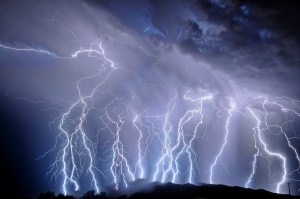
Rev. 16:17 –Then the seventh [angel] poured out his bowl into the air, and a loud voice came out of the sanctuary from the throne, saying, “It is done!” 18 There were flashes of lightning and rumblings of thunder. And a severe earthquake occurred like no other since man has been on the earth – so great was the quake. 19 The great city split into three parts, and the cities of the nations fell. Babylon the Great was remembered in God’s presence; He gave her the cup filled with the wine of His fierce anger. (HCSB)
 “It is done!”
When the seventh angel pours out his bowl into the air, a loud voice from the sanctuary declares, “It is done!” The 24 elders make a similar pronouncement in Rev. 11:15-19. They announce that “the time has come for the dead to be judged and to give the reward to Your servants the prophets, to the saints, and to those who fear Your name, both small and great, and the time has come to destroy those who destroy the earth” (v. 18).
More importantly, this cry echoes the declaration of a triumphant Jesus on the cross. Just before His death He shouts, “It is finished!” At Calvary, the Son of Man completes the work of redemption, bearing our sin and receiving the wrath of God on our behalf. Like a Roman commander overlooking the battlefield, He shouts, “It is finished!” because He has vanquished the evil one and released those bound to him in captivity. And like the high priest on the Day of Atonement, He shouts, “It is finished!” because no more sacrifices will be accepted. Both the Roman soldiers and the Jews around the cross have a clear context for understanding the significance of the Lord’s declaration. Jesus has fulfilled the law through His sinless life; fulfilled the types and shadows of the Old Covenant; fulfilled the prophecies of Messiah’s suffering; and completed the task for which the Father sent Him and the Spirit empowered Him. The work of redemption – it is finished!
 OnceDelivered.net