
Tagged: books on Satan

Anointed Guardian Cherub – Part II
The following excerpt is taken from What Every Christian Should Know About Satan. Order your copy in print, Kindle, or Audible versions here.

Check out Part I of this chapter.
When considered together, Isaiah 14 and Ezekiel 28 invite different interpretations. Three rise to the top: (1) the authors are describing the depravity of earthly kings, using exaggeration and/or sarcasm; (2) the authors are describing both earthly kings and – in Ezekiel 28 in particular – the fall of Adam; and (3) the authors are describing both earthly kings and Satan, peeling back the curtain to expose a supernatural creature who pulls the strings of his marionette monarchs.
Trusted Bible scholars vigorously debate which interpretation best fits the text. So, let’s briefly survey each view.
View 1: earthly kings
Many commentators see Isaiah 14 and Ezekiel 28 as graphic depictions of wicked earthly kings, with hyperbole and/or sarcasm employed to show the folly of the rulers’ bloated self-esteem.
Kenneth Boa and Robert Bowman favor this view. In Isaiah 14, the prophet directly addresses the king of Babylon (v. 4) and specifically refers to him as a “man” (v. 16). But the prophecy also draws on pagan mythology to depict the king’s fall from power. For example, in one Canaanite myth, a god named Athtar (meaning something like “son of Dawn” or “morning star”) wanted to rule on Baal’s throne from Zaphon, a sacred mountain to the north. Compare “the North” (CSB) with “Zaphon” (NRSV) in verse 13 and see the connection. So, according to this view, Isaiah likely is using religious imagery typical for his time to describe the humiliation of an arrogant earthly king.
Continue reading
When and How Did Satan Fall?
This excerpt is taken from What Every Christian Should Know About Satan from High Street Press. Order your paperback, Kindle, or Audible copy here.

Scripture offers no clear answers as to when and how Satan originally falls – or even why a sovereign God permits the evil one’s rebellion and all its horrific consequences. Genesis 3 does not introduce us to the origin of evil, but reveals the presence of unexplained evil in the serpent. Adam and Eve are created innocent, and shortly thereafter the already-fallen serpent shows up. John Piper’s candid perplexity is a welcome perspective.
In response to a listener’s question about where Satan even got the desire to sin, Piper replies, in part: “As far as I can see, no explanation is offered in the Bible for how Satan became evil…. How could a perfectly good being – with a perfectly good will and a perfectly good heart – ever experience any imperfect impulse that would cause the will to move in the direction of sin? The answer is that nobody knows ….”
Piper goes on:
Continue readingHere is what I do know. God is sovereign. Nothing comes to pass apart from his plan, which includes things he more or less causes directly – things he more or less permits indirectly. There is no doubt in my mind that Satan’s fall and all the redemptive plan of God for the glory of grace afterward were according to God’s eternal plan….
God can see to it that something comes to pass which he hates. This is what he did, for example, when he planned the crucifixion of Jesus, according to Acts 4:27-28. The murder of Jesus was sinful, and it was planned down to the detail by God.… I think the Bible leads us to believe that he is sovereign over all sin and that he never sins. That is what I believe the Bible teaches.
John Piper
Anointed Guardian Cherub
Following is an excerpt from What Every Christian Should Know About Satan. Order your copy now in paperback, Kindle, or Audible versions.
Marcus Licinius Crassus was one of the wealthiest and most powerful men in ancient Rome. Born in 115 BC, he amassed a fortune through various enterprises, which ranged from dealing in slaves to restoring fire-ravaged land and selling it at huge profits. His wealth enabled him to crush rivals and buy influence with Julius Caesar. In fact, he bankrolled the army sent out to quash the Spartacus-led slave rebellion.
In gratitude, Caesar named Crassus governor of Syria, a land rich in resources. It should have been one more step in Crassus’ meteoric rise, but he flamed out like a falling star. He led a disastrous campaign against the Parthian Empire. After the battle of Carrhae, he parlayed for peace. But the Parthians poured liquid gold down his throat. One of the richest men who ever lived choked to death from a scalding dose of what he valued most in life. An exalted crony of Caesar, Crassus died in humiliation – a spectacle for the ancient world to behold.
Curiously, we know more about Crassus’ rise and fall than we do about Satan’s. The Bible offers little insight into the evil one’s exaltation and rebellion, although it does tell us something of his fall and ignominious destiny. We know the devil is a created being. We know he is powerful, clever, deceitful, rapacious, and deadly. We know he throws his full weight into a guerilla campaign against God and God’s people. We know he has a vast army of evil spirits who engage holy angels and humans in spiritual warfare. We know he has a kingdom and great authority over those he has taken captive.
But we also know his limits. Satan is neither omniscient, omnipotent, nor omnipresent, for these attributes belong to God alone. Equally important, we know that no matter how highly exalted he once was, or makes himself appear today, he is on a steep downward trajectory. He has been cast out of God’s throne room and banished from the heavenly realm. Today, he furiously bides his time prowling the earth. One day, the fires of hell – stoked particularly for him and his minions – are to be his everlasting place of torment (Matt. 25:41).
But when did Satan become the evil one? How did wickedness rise in his heart? How did he ever get the notion he could defeat his creator? And why does he insist on taking as many people to hell with him as possible?
Continue reading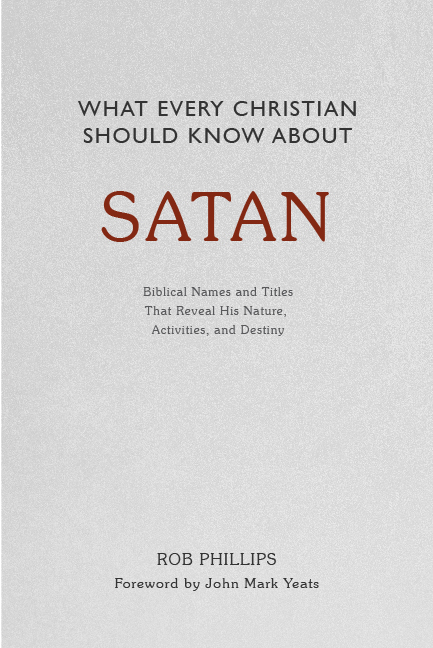
What Every Christian Should Know about Satan
 The Missouri Baptist Convention, through its High Street Press imprint, has released a new resource for personal or group study titled What Every Christian Should Know about Satan.
Written by the MBC’s Rob Phillips, the 400-page book explores more than a dozen biblical names and titles that reveal the evil one’s character, tactics, and ultimate destiny in hell. It’s designed for pastors and laypersons who desire a deeper study of Satan’s doomed campaign against God and God’s people.
Curiously, the Hebrew satan means “accuser” and is not a title devoted solely to the evil one. Even the angel of the Lord – the preincarnate Christ – plays the role of satan / accuser on one occasion (Num. 22). However, God’s progressive revelation in Scripture reveals one particular accuser who stands in opposition to his Creator – the diabolos, or devil, of the New Testament.
Numerous biblical names and titles appear, focusing on a single fallen angel who reigns over a host of demonic followers. These names include: dragon, serpent, father of lies, murderer, tempter, deceiver, evil one, Beelzebul, ruler of this world, and destroyer.
 OnceDelivered.net