
Tagged: commentary on Revelation

Revelation 16: Download the free study
 We are continuing to work through the Book of Revelation with a focus on four major views of the so-called Apocalypse of John. You may read the commentary to date by clicking here.
Whether you’re a preterist, who sees the events of Revelation as fulfilled in the first centuries of the Christian era, a historicist, who views the events of Revelation as unfolding throughout the course of history, a futurist, who sees most of Revelation as yet unfulfilled, or an idealist, who sees Revelation setting forth timeless truths concerning the battle between good and evil, there are important truths the Lord reveals to all of us in this book.
We would do well to approach Revelation with caution — and with great anticipation, knowing God will fulfill all His promises to us. We also should be comforted by the fact that Revelation is the only book in Scripture specifically promising a blessing to those who hear its prophecies and keep them.
With that in mind, and to make it easier to keep our notes together, we have captured the commentary into single Adobe files (pdfs) that you may download, print and share. Click on the links below to capture notes on chapter 15. If you missed the link to notes on any other chapters to date, links are provided as well.
Download the pdf: Revelation 16
Download the pdf: Revelation 15
Download the pdf: Revelation 14
Download the pdf: Revelation 13
Download the pdf: Revelation 12
Download the pdf: Revelation 11
Download the pdf: Revelation 10
Download the pdf: Revelation 8-9
Download the pdf: Revelation 6-7
Every island fled – Revelation 16:20-21
Previously: “It is done!” – Revelation 16:17-19
The scripture
Rev. 16:20 – Every island fled, and the mountains disappeared. 21 Enormous hailstones, each weighing about 100 pounds, fell from the sky on people, and they blasphemed God for the plague of hail because that plague was extremely severe. (HCSB)
 Every island fled
Verse 20 reads, “Every island fled, and the mountains disappeared.” Some translations say the islands “disappeared” or “vanished.” There is a similar image from the sixth seal in Rev. 6:14. We are told that “every mountain and island was moved from its place.” All of creation is shaken violently in preparation for its renovation into new heavens and a new earth, although some see this in figurative terms as the dramatic end to the times of the Jews and/or the Roman Empire.
Those who see this passage as a prelude to the return of Christ note that Rev. 21:1 tells us that the first heaven and earth have passed away and the sea exists no more.
Isaiah pictures a day when the Lord of Hosts is coming “against all that is proud and lofty, against all that is lifted up – it will be humbled – against all the cedars of Lebanon, lofty and lifted up, against all the oaks of Bashan, against all the high mountains, against all the lofty hills, against every high tower, against every fortified wall, against every ship of Tarshish, and against every splendid sea vessel. So human pride will be brought low, and the loftiness of men will be humbled; the Lord alone will be exalted on that day” (Isa. 2:12-17).
Assemble them for battle: Revelation 16:14-16
Previously: The sixth bowl: Revelation 16:12-16
The scripture
Rev. 16:14 – For they are spirits of demons performing signs, who travel to the kings of the whole world to assemble them for the battle of the great day of God, the Almighty. 15 “Look, I am coming like a thief. Blessed is the one who is alert and remains clothed so that he may not go naked, and they see his shame.” 16 So they assembled them at the place called in Hebrew Armageddon. (HCSB)
Assemble them for the battle … in Armageddon
Now the kings of the world are assembled for “the battle of the great day of God, the Almighty” (v. 14). Verse 16 tells us the evil spirits assemble the kings at “the place called in Hebrew, Armageddon.” This is the only mention of “Armageddon” in the Bible. But the place is well known. The word “Armageddon” in Hebrew is har-megiddon, meaning “the mount of Megiddo.” Although there is no mountain by this name, the great city of Megiddo is strategically placed to guard the pass between the Mediterranean coast and the valley of Jezreel or Esdraelon.
 The outcome of this battle is reported in Rev. 17:14 and 19:11-21 as the Lamb obliterates the forces of evil. As the Dictionary of Biblical Prophecy and End Times points out, the gathering of the wicked for destruction is a common theme in the Old Testament. For example:
- In Joel 3:11-16 the Lord invites the nations to come to the “Valley of Jehoshaphat, for there I will sit down to judge all the surrounding nations.”
- In Zeph. 3:8 the Lord declares, “For My decision is to gather nations, to assemble kingdoms, in order to pour out My indignation on them, all My burning anger; for the whole earth will be consumed by the fire of My jealousy.”
- And in Zech. 12:3-4 and 14:2-5 Yahweh promises, “On that day I will make Jerusalem a heavy stone for all the people; all who try to lift it will injure themselves severely when all the nations of the earth gather against her…. I will gather all the nations against Jerusalem for battle…. Then the Lord will go out to fight against those nations as He fights on a day of battle …”
More specifically, the valley of Jezreel or Esdraelon is the site of many important battles in the history of Israel. It is the place where earthly kings are no match for the Lord’s heavenly host; indeed, they are punished for oppressing God’s people (Judges 5:19). It is where the prophets of Baal are slaughtered in the days of Elijah (1 Kings 18:40). And it is where good king Josiah is killed, resulting in national mourning (2 Kings 23:29; 2 Chron. 35:20-25).
A common thread in these battles is that this valley is a place where unrighteous nations attack the people of God. Certainly, Megiddo in scripture is connected with warfare. It’s possible, however, that John’s reference to Megiddo is in fact a reference to Jerusalem. David Stern writes, “[T]he final war may not take place at Har Megiddo at all, but in Jerusalem, at Har Migdo, the ‘mount of his choice fruit,’ i.e., the mountain of God’s blessing, Mount Zion. Mount Zion has already been mentioned at 14:1; moreover, the imagery resembles Joel’s picture of the Day of Adonai, when God’s power goes forth from Mount Zion against the forces of evil (Joel 2:1-11, 4:16-17 [3:16-17]; compare also Isaiah 31:4-9). The next passage (vv. 17-21) resembles 14:14-20, which also draws on imagery from Joel 4…. Strengthening the case further Zechariah 12:11 … mentions Jerusalem along with Megiddon” (Jewish New Testament Commentary, p. 835).
So how should we view Armageddon?

The sixth bowl: Revelation 16:12-16
Previously: The fifth bowl – Revelation 16:10-11
The scripture
Rev. 16:12 –The sixth [angel] poured out his bowl on the great river Euphrates, and its water was dried up to prepare the way for the kings from the east. 13 Then I saw three unclean spirits like frogs [coming] from the dragon’s mouth, from the beast’s mouth, and from the mouth of the false prophet. 14 For they are spirits of demons performing signs, who travel to the kings of the whole world to assemble them for the battle of the great day of God, the Almighty. 15 “Look, I am coming like a thief. Blessed is the one who is alert and remains clothed so that he may not go naked, and they see his shame.” 16 So they assembled them at the place called in Hebrew Armageddon. (HCSB)
Its water was dried up
The Euphrates River figures prominently in both the sixth trumpet judgment and the sixth bowl judgment. As you may recall, in the sixth trumpet judgment four demons bound at the Euphrates are released to lead a vast army that kills a third of the human race. Here, in the sixth bowl judgment, the waters of the great river are dried up to make way for the “kings of the east.”
 In 536 B.C., Cyrus the Persian devises a plan to divert the flow of the Euphrates River, which runs under the wall surrounding Babylon. This enables his soldiers to march under the wall, take Belshazzar by surprise and capture the city without serious resistance. It’s possible that John is drawing from this well-known historic event to prepare his readers for a swift and certain act of judgment, although it’s not necessary to interpret the drying of the waters literally. In fact, many commentators see the river as a symbol for political or religious boundaries, impediments to the advance of evil forces, or the geographic region from which many of Rome’s soldiers came to destroy Jerusalem in 70 A.D.
Some futurists, however, believe the Euphrates will indeed dry up, enabling a coalition of Eastern powers to sweep into the Holy Land. While the implication is that the water is dried up by an act of God, “the fact is that dams have been built across the Euphrates River in this [20th] century to divert water for irrigation so that there are times even today when there is little or no water in the Euphrates” (J.F. Walvoord, R.B. Zuck, The Bible Knowledge Commentary: An Exposition of the Scriptures, Rev. 16:12).
It’s worth noting the similarities between what happens here and what occurs in the crossing of the Red Sea and the march across the Jordan River as God’s people pass out of bondage and into the Promised Land. The miracle that Israel experiences in Old Testament times is now repeated in a negative sense, say preterists, as the first-century Jews who have rejected their Messiah are called into account for their national sin.
The second bowl – Revelation 16:3
Previously: The first bowl – Revelation 16:1-2
The scripture
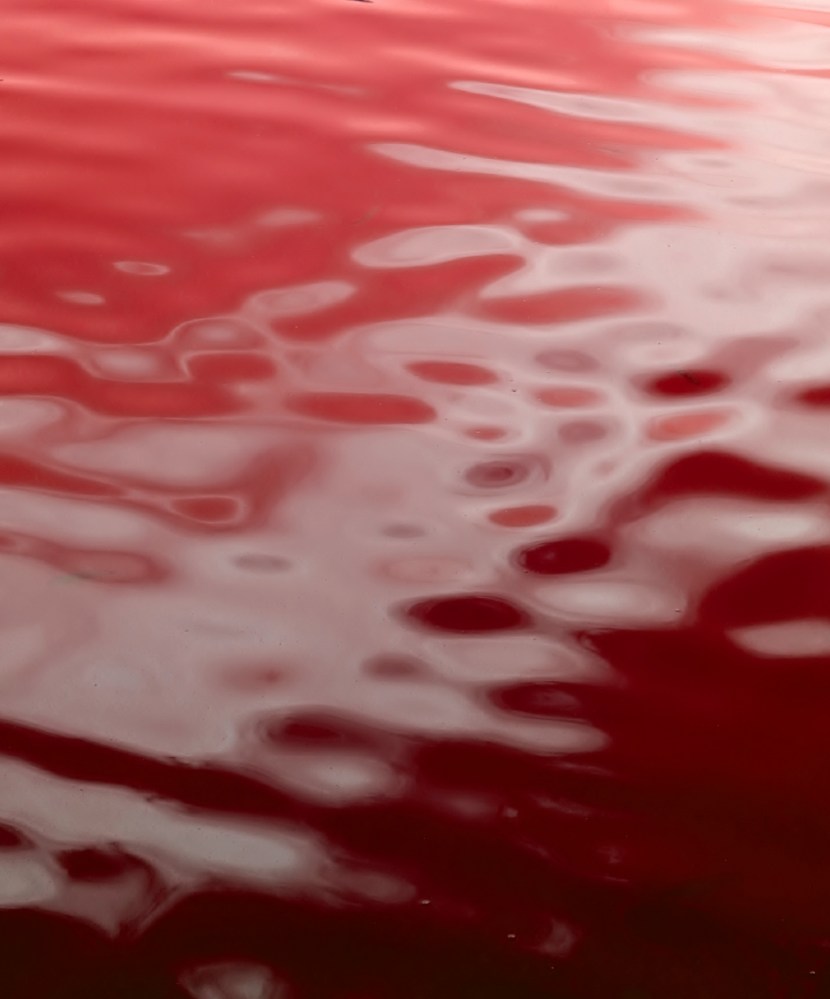
Rev. 16:3 –The second [angel] poured out his bowl into the sea. It turned to blood like a dead man’s, and all life in the sea died. (HCSB)
The sea turned to blood
 John records that the target of the second angel’s bowl of divine wrath is the sea, which turns to blood like a dead man’s. There are two key questions to be addressed here. First, what is meant by the “sea?” And second, what is the significance of the sea turning to blood “like a dead man’s?”
As we have noted in previous chapters, Bible scholars interpret the meaning of the sea differently in Revelation:
- Some understand it literally to mean the salty bodies of water that cover much of the earth’s surface. The seas turn red by the hand of God, or as a result of divinely orchestrated human battles; some argue that a bacterial “red tide” may be the cause of perishing sea life. The widespread death of people and/or animals in the sea would create a putrid environment that clogs the waterways with coagulating blood like a dead man’s.
- Others argue for a narrower but equally literal view, saying John is referring to the Mediterranean Sea, or to the waters between Patmos, where John is exiled, and Rome; this would include not only the Mediterranean Sea, but the Aegean, Adriatic and Tyrrhenian Seas. This presupposes that the bowl judgments are poured out on the known world of John’s day rather than on all the earth’s seas.
- Many preterists contend that the Sea of Galilee is in John’s view since that is where the Roman armies inflict a particularly horrifying slaughter of the Jews during their first-century rebellion against the empire. In fact, the result of the battle is that the sea becomes a floating tide of corpses, severed limbs and bloody pools.
- Some historicists say the sea depicts the ocean centuries later as the navies of France, Spain and Portugal suffer bloody defeats while defending a corrupt papacy. Matthew Henry suggests the bloody seas may describe “the whole system of [Papal Rome’s] religion, their false doctrines, their corrupt glosses, their superstitious rites, their idolatrous worship, their pardons, indulgences, a great conflux of wicked inventions and institutions, by which they maintain a trade and traffic advantageous to themselves, but injurious to all who deal with them…. God discovered not only the vanity and falsehood of their religion, but the pernicious and deadly nature of it – that the souls of men were poisoned by that which was pretended to be the sure means of their salvation” (Matthew Henry’s Commentary on the Whole Bible: Complete and Unabridged in One Volume, 16:1-7).
- Still others take a symbolic approach, contending that the sea stands for the Gentile nations, or the restless mass of humanity in general.
Whether this vision is to be understood literally or figuratively, the sea turning to blood “like a dead man’s” conveys the idea of massive and complete death. The waters swell with putrefied corpses. Life’s blood has been spilled beyond the hope of healing. Death, destruction, and decay assault the eyes and inflame the nostrils. This is graphic, violent, sense-numbing death. Even if we take John’s description symbolically, the corruption of people, nations, and institutions is complete. The false doctrines are a stench in God’s nostrils. The corrupt practices of people, governments, and religious institutions are beyond repair; like corpses, they must be discarded. John seems here to be telling us that God’s punishment fits the crime. The wicked are so depraved nothing short of death will vindicate His holiness.
Continue reading
 OnceDelivered.net