
Satan’s Temptation of Jesus
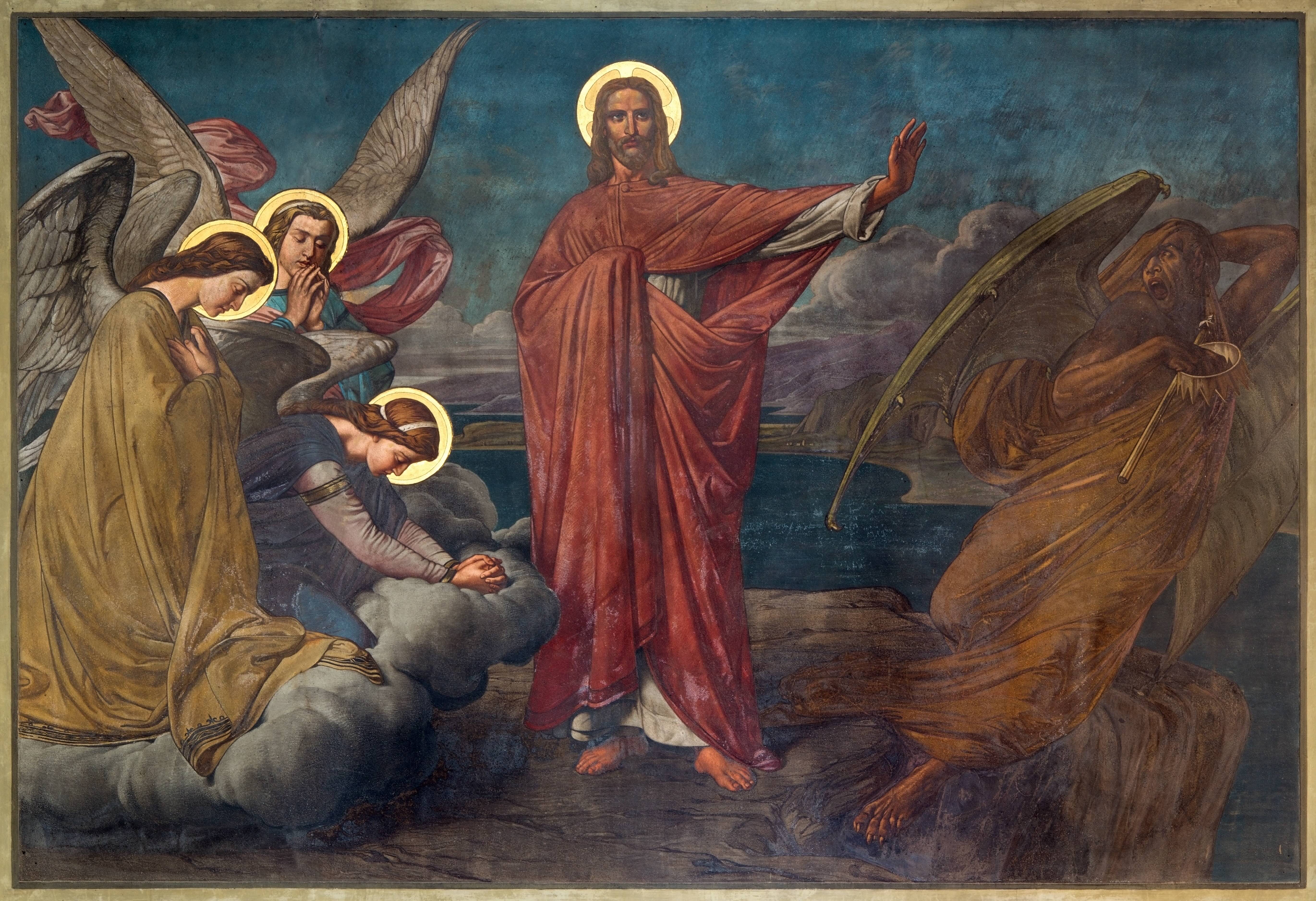
The following excerpt is taken from What Every Christian Should Know About Satan. Order your copy in print, Kindle, or Audible versions here.
All three synoptic Gospels record the account of Jesus’ temptations in the wilderness. Let’s look at Matthew’s record since it alone refers to Satan as the tempter, although Mark and Luke are clear that it is the evil one tempting Jesus during this encounter.
Matthew 4:1-11 reads:
Then Jesus was led up by the Spirit into the wilderness to be tempted by the devil. After he had fasted forty days and forty nights, he was hungry. Then the tempter approached him and said, “If you are the Son of God, tell these stones to become bread.”
He answered, “It is written: Man must not live on bread alone but on every word that comes from the mouth of God.”
Then the devil took him to the holy city, had him stand on the pinnacle of the temple, and said to him, “If you are the Son of God, throw yourself down. For it is written: He will give his angels orders concerning you, and they will support you with their hands so that you will not strike your foot against a stone.”
Jesus told him, “It is also written: Do not test the Lord your God.”
Again, the devil took him to a very high mountain and showed him all the kingdoms of the world and their splendor. And he said to him, “I will give you all these things if you will fall down and worship me.”
Then Jesus told him, “Go away, Satan! For it is written: Worship the Lord your God, and serve only him.”
Then the devil left him, and angels came and began to serve him (emphasis added).
No sooner does the Holy Spirit descend on Jesus, empowering the incarnate Son of God for public ministry, than he leads Jesus into the wilderness for an extended time of temptation. While Matthew and Luke say the Spirit leads Jesus into the wilderness, Mark uses a more emphatic verb: ekballo, which means to drive out, cast out, expel, or compel one to depart. The verb may imply violence, but it also may be used to denote drawing out, extracting, or leading one away with an irresistible force.
Likely, this is the sense in which Jesus is led into the wilderness. It is Jesus’ first act of submission to the will of the Father after the Spirit’s descent. And there is no doubt the Spirit accompanies Jesus on this otherwise solitary mission.
We should keep in mind the similarities between Jesus’ forty days of testing in the wilderness and the Israelites’ forty years of testing after God delivers them from Egypt. In both cases, the divine presence of Yahweh accompanies them – the Shekinah glory in the pillar of cloud and fire for the Israelites, and the Holy Spirit for Jesus.
In both cases, God’s law is revealed and available. In both cases, temptation comes in appeals to fleshly desires, false gods, and prideful possessions. But the outcomes are starkly different. The Israelites fail the test; Jesus passes with flying colors.
The first temptation. Satan appeals to Jesus’ hunger, urging the Son of God to prove himself by turning stones into bread. This appeal is to the “lust of the flesh” (1 John 2:16). Will the incarnate Creator use his infinite power to save himself?
Three years later, a similar taunt is hurled Jesus’ way. As he hangs naked and bloody on the cross, passersby yell insults and shake their heads, saying, “You who would destroy the temple and rebuild it in three days, save yourself! If you are the Son of God, come down from the cross!”
Similarly, the chief priests, scribes, and elders mock him: “He saved others, but he cannot save himself! He is the King of Israel! Let him come down now from the cross, and we will believe in him. He trusts in God; let God rescue him now – if he takes pleasure in him! For he said, ‘I am the Son of God.’” Even the criminals crucified with Jesus can’t resist chiming in (Matt. 27:39-44).
There is nothing inherently sinful about turning stones into bread. Later, on two occasions, Jesus multiplies loaves of bread and fish to feed thousands (Matt. 14:13-21; 15:32-39). So, it isn’t the miracle itself that would prove sinful, but the abuse of divine power for personal gratification. As Sharon Beekmann notes, “In this regard, the devil’s temptations are not always to do something inherently sinful, but to do something outside of the will of God. A miracle in the service of Satan is magic.”
No doubt, Jesus is famished. Perhaps for the first time, the eternal Son of God is experiencing the extreme limits of human endurance. What harm would there be for the one who created all things (John 1:3; Col. 1:15) to conjure up a few morsels of bread? But Jesus understands his earthly role – to serve, not to be served – and he understands the subtlety of Satan’s siren call. And so he responds, “It is written: Man must not live on bread alone but on every word that comes from the mouth of God” (Matt. 4:4).
In the wilderness, God provided manna on a daily basis to teach the Israelites to trust fully in him, but they were not to demand that he satisfy their hunger (Deut. 8:3). Of course, the Israelites failed the test. But Jesus’ reply to Satan shows the priority of maintaining close fellowship with the Father, who sustains his Son throughout his earthly mission.
Later, Jesus declares: “I am the bread of life. No one who comes to me will ever be hungry, and no one who believes in me will ever be thirsty again” (John 6:35). Only a sinless God-man is able to sustain spiritually hungry people.
The second temptation. Next, the devil appeals to Jesus’ sense of self-importance, or as John depicts it, “the lust of the eyes” (1 John 2:16). Satan takes Jesus to the precipice of the temple, a towering vantage point more than a hundred feet above the shimmering pavement below. No doubt, many religious leaders and earnest supplicants are busily going about their business and would make an ideal audience for a divine parlor trick. What better way to launch a public ministry than with an open display of supernatural power.
The devil tells Jesus not to worry about spilling his guts on the stones beneath him. The Father is sure to send angels to cushion the fall. Here, Satan cleverly misquotes Psalm 91:11-12: “He will give his angels orders concerning you, and they will support you with their hands so that you will not strike your foot against a stone.” However, the evil one makes two deliberate errors. First, he leaves out part of verse 11: “to protect you in all your ways.” Second, he lifts the psalm out of context.
We explore Psalm 91 in greater depth in Chapter 5. Generally, it lays out the physical protection Israelites enjoy when they trust completely in the Lord. We see this many times in God’s deliverance of his people from a variety of dangers. It is not, however, a proof text that guarantees every Israelite a problem-free life. More to the point, Psalm 91 seems to speak directly of David, while alluding to the coming Messiah, as verse 13 notes: “You will tread on the lion and the cobra; you will trample the young lion and the serpent.”
Satan’s choice of Psalm 91:11-12 is a calculated effort to short-circuit Jesus’ role as the messianic Son of God. The father of lies quotes from the psalm but craftily misapplies it. Christ’s purpose in the Incarnation is not to entertain audiences, satisfy his human desires, or become a puppet king under the authority of the god of this age. No, Jesus comes to earth to die, and to rise again, to redeem sinful and fallen people.
So, how does Jesus respond to Satan’s argument from Scripture? He replies, “It is also written: Do not test the Lord your God” (Matt. 4:7). This quotation comes from Deuteronomy 6:16: “Do not test the LORD your God as you tested him at Massah.” Massah recalls the people’s quarreling with God at Mount Horeb, where they questioned the Lord’s wisdom in delivering them from Egypt (Exod. 17:1-7). After obediently striking a rock to provide water for the people and their livestock, Moses names the place Massah, which means “testing,” and Meribah, which means “quarreling” (Exod. 17:7).
Just as the Israelites demanded instant gratification from Yahweh in the wilderness, Satan tempts Jesus to press the Father for a miracle that would theatrically introduce the Son of God and dazzle the crowds. It seems like a reasonable request if Jesus’ primary purpose is to openly display his deity and thus revel in divine glory. Yet for much of the next three years, Jesus carefully cloaks his deity, as well as his identity as Messiah, until the proper time comes to reveal them both.
To launch his public ministry with a death-defying plunge from the temple’s pinnacle does nothing to advance Jesus’ mission to seek and to save the lost (Luke 19:10). Further, to engage in such antics at Satan’s behest is to succumb to the same temptation the Israelites experienced at Massah.
The third temptation. The devil takes Jesus to “a very high mountain” and shows him all the kingdoms of the world and their splendor (Matt. 4:8). Perhaps this is Mount Hermon, the highest peak in Israel, where Jesus likely is transfigured before Peter, James, and John (Matt. 17:1-9). It is a significant mountain in Israelite history. The headwaters of the Jordan River gush from its base. But also, in the foothills of Mount Hermon lies Caesarea Philippi, a place noted for idolatry, featuring caves believed to be the gates of hades. In any case, Satan gives Jesus a clear view of all the world has to offer, appealing to “the pride in one’s possessions” (1 John 2:16).
Further, Satan makes it clear these kingdoms are his to give: “I will give you their splendor and all this authority, because it has been given over to me, and I can give it to anyone I want” (Luke 4:6). Now, Satan’s true intentions are revealed. He wants Jesus to worship him, to acknowledge him as sovereign lord of the earth.
If only Jesus grants Satan’s request, the world Jesus came to redeem would be his – without the cross. No contentious debates with Israel’s religious leaders. No walking the dusty roads of Judea, Galilee, and Samaria. No escaping the plots to kill him, or to make him king. No betrayal at the hand of a close friend. No kangaroo court in Pilate’s presence. No brutal beatings. No agonizing crucifixion. Just bend the knee to Satan and everything Jesus came for is granted, no questions asked.
But Jesus sees through Satan’s lies. Satan is a usurper. He may well be “the ruler of this world” (see Chapter 12), but he occupies a realm that already belongs to God. He took it through deception and plunged it beneath a curse (Gen. 3). Jesus has not come to barter for the world. He has come to storm the strong man’s house and plunder his goods (Matt. 12:29). Further, anything Satan owns or controls is by God’s divine permission. The evil one may prowl the earth, but he is a lion on a leash.
Further, Satan has no rightful claim to worship; that is for God alone. That’s why Jesus responds to Satan’s invitation with these words: “Go away, Satan! For it is written: Worship the Lord your God, and serve only him” (Matt. 4:10). Jesus quotes from Deuteronomy 6:13, which follows the most well-known portion of the Shema, the centerpiece of daily morning prayer services, and considered by some the most essential prayer in all of Judaism: “Listen, Israel: The LORD our God, the LORD is one. Love the LORD your God with all your heart, with all your soul, and with all your strength” (Deut. 6:4-5).
Jesus would come to reign over the kingdoms of this world, but not through a deal with the devil, the worship of a false god, or by any other means than the way of the cross. Jesus commands Satan to go away, and the devil departs. Interestingly, the angels Satan promised to be a safety net for Jesus beneath the pinnacle of the temple now come and serve him (Matt. 4:11).
Lessons from the wilderness
What may we learn from Jesus’ victorious encounter over the evil one? A few observations may prove instructive. First, maintaining relational harmony with the Father is key to resisting the devil. Jesus came to do the Father’s will. Jesus’ conversations with the Father, and his proclamation of the Father’s will, punctuate his earthly ministry.
Second, the indwelling Holy Spirit enables us to successfully resist temptation. While the Spirit steers Jesus into the wilderness, the Spirit does not abandon him there. Rather, he is present with Jesus the entire time. The Spirit, too, helps followers of Jesus pray, proclaim, and persevere. He has sealed us and is the guarantee of our future glorification. In the meantime, he indwells our human spirits, residing in the holy of holies of our bodily temples (1 Cor. 3:16; 6:19).
Third, the Word of God is our best defense. Paul calls God’s Word the sword of the Spirit (Eph. 6:17). With the inspired, inerrant, infallible, and authoritative Word of God, we extinguish Satan’s flaming darts of temptation. Scripture memorization is the best way to carry the sword of the Spirit in our sheath, ready to be drawn at a moment’s notice.
Fourth, we should realize that the devil’s temptations of Jesus are designed specifically for him as the Son of God. They are not necessarily the model of how the evil one lures us into sin. Further, since Satan may only be in one place at a time, it’s more likely that he sends evil spirits to tempt us, although he certainly may choose to buffet us himself.
Fifth, Satan and evil spirits often employ common tools, which Satan uses to tempt Jesus. Demons tempt us with physical cravings, the delights of the world, and our desire for personal prestige and power.6 These are the things of the world, which John outlines in 1 John 2:15-16. The lust of the flesh, the lust of the eyes, and the sinful pride of life are common human vulnerabilities.
We experience the physical world with our five senses. Satan desires that we delight in sensual pleasures in ways God never intended. We dream the possible – or perhaps the impossible – with our imaginations. And while thinking about and planning for the future is no sin, we may be drawn into sin if we allow the cares of this world to consume us (Matt. 13:22; Jas. 1:14-15).
We should fear no human being or consider ourselves less worthy to display the imago dei – the image of God. But when thoughts of our own selves take us to imagined heights above others, we violate the very example of Christ, who, being equal with the Father, humbled himself and became obedient unto the point of death on a cross (Phil. 2:5-11).
Sixth, as in his wilderness encounter with Jesus, Satan does not always tempt us to do something inherently evil. In fact, he often woos us to take something God created for good – an activity related to food, sex, relationships, possessions, authority – and experience it in ways that run counter to God’s design. The apostle Paul offers a fairly comprehensive list of sins the devil makes irresistible: sexual immorality, moral impurity, promiscuity, idolatry, sorcery, hatreds, strife, jealousy, outbursts of anger, selfish ambitions, dissensions, factions, envy, drunkenness, carousing, and anything similar (Gal. 5:19-21).
Seventh, Satan tempts in ways that make us think we are part of something divine. In some of his sneakier work, the devil tempts us through false signs, wonders, and other miracles, counterfeiting the true supernatural work of God (Mark 13:22; 2 Cor. 11-12; Rev. 13:13-14).
We are wonderfully created beings who bear the image of God. Our creator values us and desires an intimate, everlasting relationship with us. We are built to live forever, and we are invited to a glorified eternity. But our flesh is weak (Mark 14:38), we have feet of clay, and we are easily lured away from complete dependence upon God (Jas. 1:14).
Even so, in the end, we are responsible for the choices we make, and we bear the penalty of our own sins, unless we take part in the great exchange – in which our sins are imputed to Jesus, and his righteousness is imputed to us.
We should always keep in mind the words of the writer of Hebrews about Jesus:
For we do not have a high priest who is unable to sympathize with our weaknesses, but one who has been tempted in every way as we are, yet without sin. Therefore, let us approach the throne of grace with boldness, so that we may receive mercy and find grace to help us in time of need (Heb. 4:15-16).
Next: The Thessalonians’ tempter
 OnceDelivered.net